



‘How are you all using AI?’ the professor asked. This wasn’t in the Socratic tone of an educator. Instead, there in the halls of the Army’s Senior Service College (SSC) auditorium, it was an old asking a youngster just what this new-fangled tech was all about. Except we ‘youngsters’ were all over forty.
The instructor’s inquiry made sense. It was in fact a credit to an institution I too often beat up. The army didn’t know much about a half-dozen novel subjects, and so it had given us missionaries the challenge to go and find out. That summer day in 2024, the audience wasn’t comprised of typical war college students — they’d be arriving next week. Those regular SSC students would spend the next ten months in Carlisle being pumped full of everything the army new about strategy and operations.
In contrast, 82 of us would be sent afield away from the army. We were headed to colleges, corporations, foreign militaries — and in my case a think tank — to go learn what the army didn’t know.
To baseline the class, the instructor was looking for early adopters in asked who among us had already experimented with these new technologies. About five of us raised our hands for AI. I offered up a vignette about my explorations with image generation. Mind you, these were the nascent days of LLM AI, when DALL-E was still drawing too many fingers on hands. No one was really vibe-coding yet, and there were even folks who talked like ‘prompt engineer’ was going to be a real job. The tech has moved a lot since then.

Two years later, one response from another fellow still lingers with me. ‘I use AI to do a lot of the bullshit tasks I don’t want to waste my time on.’ His response garnered a lot of positive head nods and interest from the assembled officers. But I had to follow up with a question, ‘Have you tried just not doing the bullshit?’
Atwood’s Ducks
I was lifting in the gym this summer when the Economist’s podcast introduced me to an animal I’ve unknowingly been living with my whole career.
In the episode, Andrew Palmer describes how employees use absurd things — pixelated ducks and potatoes — to ‘manage by paint’: give leadership a distracting decoy to avoid real issues. The apocryphal name — Atwood’s Duck — may be new, but the concept is certainly familiar to everyone who’s ever worked any job. But the army has elevated this art of doing a lot while saying nothing to our default form of communication. Perhaps that’s why I’d never heard of ‘Atwood’s duck;’ fish have no word for water.
Our army is steeped in bullshit. Picture storyboards, letters of lateness, or even our weekly — sometimes daily — SITREPs. When I was an operations officer, my assistant rightly coined ‘Captains writing to captains’: junior officers ghost writing updates for their seniors to blind forward to each other.
A non-digital example might be illustrative. A decade ago, in the fall of 2016, my unit was preparing for a VIP visit to our compound. It was the eponymous season, so we shanghaied hundreds of soldiers to combat the autumnal scourge: leaves.
Two days before the visit, the whole compound was raked. Then the day before, it was raked again. On the day of we brought soldiers in early so they could stand ready at dawn to charge out and rake again. We even had teams of soldiers on hand in the hours before the visit. Picture dozens of sniper teams at the ready with spotting scopes to quickly eliminate any leaf that might dare. Some of these teams were comprised of literal snipers.
We were so caught up with leaves we forgot about the ‘duck’. By the time the VIP arrived in the early afternoon, a few hundred transgressing leaves had inevitably drifted to the earth, scattered throughout the compound. In our zealous hunt for fallen foliage we’d cleared every pile. We had erased our proof of work, leaving an inevitable littered of fresh leaves.
The VIP was not impressed by our hard work. Near as I could tell, they never noticed any of it. All we’d done was waste a lot of soldier’s time.
The Digital Transformation Illusion
Performative work has long been the army’s love language. Today, in an army desperate to prove it is using data, the dashboard serves as the go to for ‘management by paint.’ Ostensibly I should be all for dashboards. I loathe PowerPoint and love data. I started Downrange Data to move the army forward, to show commanders and soldiers what data can do for our formations.
But this is why so many dashboards bother me. Their default is a Christmas tree overladen with every shiny piece of tinsel data units can get their hands on. We’re left with garish displays of everything which clarify nothing.

Worse, we have too many leaders who don’t understand their limitations but have found ways to bludgeon subordinates with them anyway. They are data toddlers with a tool they cannot understand, never mind make.

The easiest way to separate a good dashboard from a bad one is to measure the distance is between you and the data. Excel pivot tables put the underlying data just a single click away in 1994. Today, most dashboards I’ve interacted with never let you touch the underlying data. Instead, they are just another of Atwood’s ducks. They are H1 dead ends dressed up as H2- work.
Eisenhower’s Square
My last post was about gaining efficiencies, which is, at its heart, the whole point of this substack. If we want to create anything new, we need time: time to think and listen, to learn and iterate, to be wrong before we can be right. Perhaps more than anything, we need time to train.
My team was recently able to shave about a day off a month worth of work by replacing a dead form with a database — maybe a 5% improvement. This week, I showed them how to use that same database to knock out another tedious , error prone task which often consumed a couple days. This is the flywheel data can bring. Easily another 10%. We’re still doing H2- work, but we’re buying time to do H2+ thinking.
AI can create a flywheel, but using it to accelerate or offload bullshit is still a waste. It’s parallel play when we should be working together. I’m not arguing that we should squander human time doing bullshit work. I’m arguing that elimination should precede automation. Don’t blow all your tokens on tasks you should be ditching entirely. Instead of the fractional 10-15% gains my team has carved, cutting out the bullshit could see an immediate 100% improvement in your schedule.
Enter Eisenhower’s square. I was a captain when my executive officer introduced me to the simple x/y plot below. I thought the insight was both genius and his — which turns out was only half right. There are diverging opinions on where leaders should focus their effort in this diagram, with fair arguments for both courses of action.1 But no one seems to focus on eliminating the entire bottom half.
A similar x/y plot drives home the point, though this time it is about people, not tasks. Kurt von Hammerseing-Equord divided officers via lazy / hardworking and clever / stupid axes.2 Kurt’s warning was blunt:
‘One must beware of anyone who is both stupid and hardworking; he must not be entrusted with any responsibility because he will always only cause damage.’
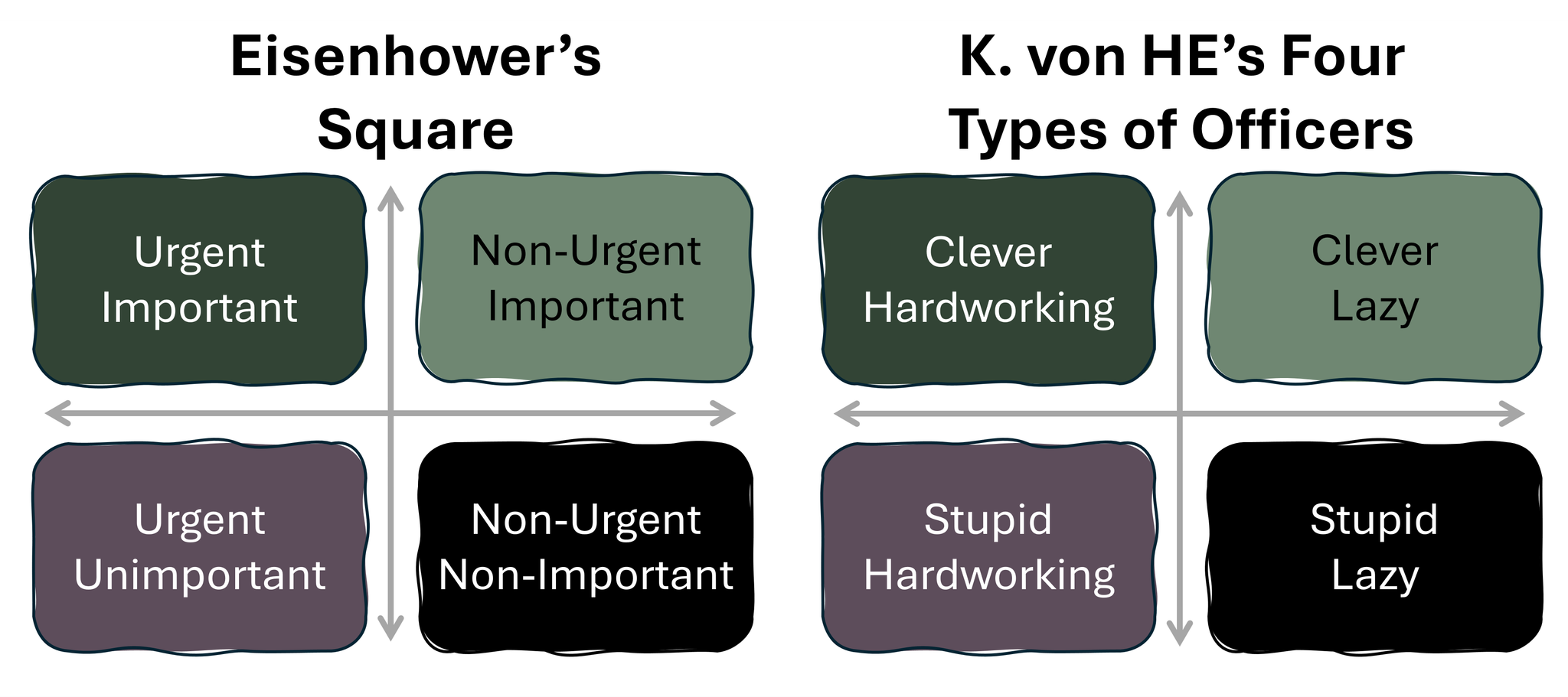
We already know that stupid but lazy people are in our formations, just like there are unimportant non-urgent tasks we try to avoid. Dim and dumb are the box wine and funyuns paring in the cul-de-sac of our corporations. They are where every unit’s McAuslan should reside; time wasters spinning their wheels on wastes of time.
But the real problem resident in both matrices is in the lower left where Atwood’s ducks live — the bullshit. Bullshit gorges on time; time we don’t have. Bullshit tasks are just like stupid-hardworking officers, because they will ‘always only cause damage’.
Everyone wants to excise that bottom left corner. But only leaders can choose not to do things. I didn’t write my first article about improving the entire army’s data literacy. It was about grooming our leaders on data. Leaders can accept risk, leaders can say ‘no’. Leaders can drive innovation — if we pick the right ones.
AI still has its shortcomings, but it is improving every day. As dumb as it might feel sometimes, it is getting smarter every day — something people cannot claim. We should be partnering with these tools to reach toward new ways of work: the H2+ steps toward H3. Using AI agents to do bullshit is just as wasteful as having snipers watch for falling leaves.
We won’t reach out to a new horizon by burning our time and tokens automating the bullshit which should be behind us.
Not really. Leaders should be in the non-urgent / important box where speedster sloths thrive.
This one is often misattributed to Napoleon, probably because his name is a lot easier to spell.