



Across the US military, there is a flurry of action this week. The good Resource Management Offices (RMOs) and G8s are putting the final touches on their budgets. The bad ones are scrambling to commit their last dollars before midnight on Wednesday, when the fiscal year ends and a new one begins. It’s a tired dance we do every year, yet somehow it always feels like our first attempt to navigate the infinite—yet minuscule—gap between September 30 and October 1.
The army does do itself any favors here - as unit executive officers normally switch out over the summer. You come into a new job you know nothing about right as the fiscal year closes. Then, just as you’re getting the hang of it, you’ll leave it the following summer, giving your replacement just a couple months to figure it out themselves. Through it all, the RMOs somehow find the reserves every year to help us soldiers navigate the transition.
It’s actually a pretty impressive to watch an RMO stick the landing on a fiscal year, not a dollar over or underspent — especially as part of an overall organization that can’t pass an audit. RMOs will track and pin down every purchase, contract, and payroll right up until midnight, then start all over the first morning of October with a fresh budget.
All across the army, every unit meticulously tracks each penny, ironically while they blithely ignore every minute.
I don’t know how much money we’ll have in FY27. We’ve got a draft budget, and even a continuing resolution that keeps us funded till just before Christmas. Even when the draft budget becomes my real budget, I’ve learned how to steal more cash from my fellow units, particularly those that can’t leverage data like I can.

Stealing money is easy. Stealing time is harder. But you cannot innovate without time.
While we’ll account for every penny in our monthly meetings, almost no one in the army is budgeting the 525,600 minutes I’ll get next year. This lack of planning is a huge part of why we are ‘Lying to Ourselves’ as a profession. No one budgeted all the sunk time costs for all the things.
We’re already overwhelmed with tasks that take more than a million minutes in a year, how can we hope to innovate? Drowning men won’t find a new way to swim — they just struggle to keep their mouth above the next wave. How will we get to the next horizon, H2+ and H3 beyond it which Pahlka told us about, if we don’t have time to try new things?

I’m not inherently innovative. I’m mostly lazy. I’m the guy in the gym who drags the rower all the way up to the pull-up bars to avoid taking one extra step. I whinge when I can’t park in the closest spot because walking is too much.
But I think we owe the lazy among us a thank you, because they’re the ones who found a way to create time. Whoever invented the wheel wasn’t trying to be innovative. We owe luggage, and cars, and tanks, and industry to some lazy caveschlub who was just tired of dragging everything around all the time. We associate lazy with sloth, and yet the lazy among us are the only ones who have found a way to manufacture time.
The faster lazy contradiction was front of my mind this past summer. A member of my team had asked for some help. She was an early adopter to new tools and so I was happy to encourage the flame. As she described her problem, I realized I’d found a kindred soul. She was tired of wasting a lot of time filling out mandatory PDF forms. She already had an excel list of all the information she needed. She asked if I could help her streamline the process.
Now, this sort of work is very much not the kind of task that an army Colonel, never mind a commander, is supposed to do. Even I knew that spending my duty day working on this would be a misallocation of time.
So, I decided to come in on one of my DONSAs to knock it out.1 This way I wasn’t wasting the government’s time; I was wasting mine. Right?
My hope was to download the PDF form and import it into excel. But you can’t do this because the army locks all of the PDFs in its library. So, I was stuck doing the same thing I did back in 2009, when I was a new SF Captain and we reengineered the 2062 hand receipt.

I made a forgery of the form on one worksheet, then set it to pull from a table of data. The whole thing took about an hour to sketch up. I rushed the beta back into her hands. I always fuck up a formula or two, so putting it through its paces with her feedback was key. She quickly spotted a few errors, then asked for refinements, and a couple of new options. She’s inquisitive and wants to understand how the tools work so she can tweak them herself. That’s another good sign of lazy people: they hate chasing down help; they want to learn enough to fix things themselves.
The form is up and running for her, saving her a bunch of time. She’s already moved on to the next thing she can replace with something simple like a spreadsheet.
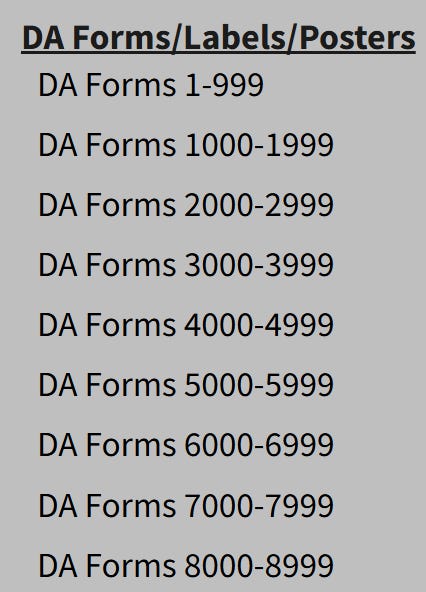
The army maintains the exhaustive repository of all its forms — and there are a lot of forms. Just about every soldier knows 1750, 2062, and 4853. In theory there’s a 2061 and a 2063 as well, though I’ve never bothered to check. Regardless, the army stewards all of them in a single database behind an ID card access wall.2 The army has kept up this repository throughout my entire career — before PDFs these were PureEdge, and FormFlow before that.3 But in all that time, it’s never made an excel version to make filling these out with data easier.
A week later I found myself working up a different spreadsheet. This time we were trying to divine the math on bonuses. Somehow, despite hundreds of units in the army doing this math — every year — there’s no template to do it. In this case it was much easier to justify me doing excel work during the duty day. I was literally putting money in my people’s hands. Once the team got all the data into a table on excel, I was able to show them not just how to set it up to calculate the algebraic answer but also format it so any minor adjustment would automatically cascade across the entire workbook, automatically updating the report. No additional work or formatting was required. Just Ctrl-P.
None of this is AI. It’s barely algebra. It’s basic excel you don’t need to go to take a course for. But hardly anyone in most organizations knows how to do it. Instead we’re burning hours doing tasks the calculators we sit in front of already do better.
This is not the work we should be doing. This is solidly H2-; entrenching existing systems through improved efficiency. I want to reach for that 3rd horizon, but I also realize we’re never going to get up on plane, never mind reach beyond it, unless we create the time to innovate. It feels very similar to space travel, where sometimes it’s more efficient to travel away from the orbit you want in order to get to your original destination. This Orbit is the WORST
What the army could do
As the holder of that massive trove of PDFs, the army is sitting on a gold mine of potential saved time for our formations. Thousands of soldiers fill out 2062s every week. Even more impactfully, every company does change of command inventories where we account for every assigned item and their basic issue inventory (BII) on a 2062.4 Most units in the army do this update every year.
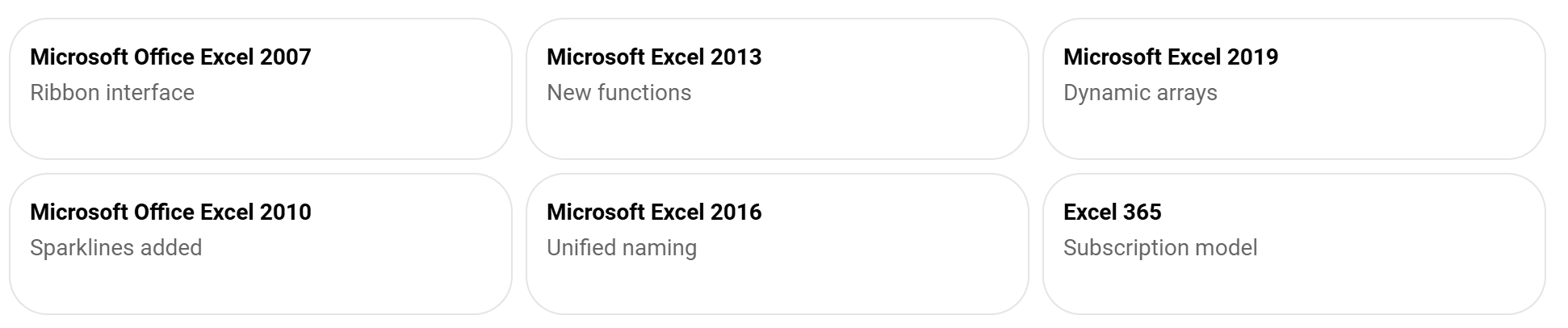
The army also already knows the BII for every item in our inventory. Building an easy to update database that generates a 2062 for you was already easy before vibe coding was a thing. We know it’s technically feasible because we already did it with Microsoft Excel 2007, which was at least six versions ago.
Today we could save the army a generation of time and manpower overnight just by automating this one form. Lord knows what the time savings could be if we leveraged data to streamline the rest of the forms…
Too often, when it’s not clear whose job something should be, no one does it. So, it never gets done. No one in the Army has the explicit job of saving everyone else time. But commanders can — and should — have that job. We already hold regular budget meetings to account for every dollar. We should use the same discipline to ask which tasks consume our people’s time, which ones can be automated, and what we will do with the hours we get back.
October 1 starts a new 365 days: 8,760 hours spread across 52 weeks. The Army could give thousands of those hours back to soldiers by streamlining its trove of PDFs. I know not every commander would agree with me about how to spend all those saved minutes. But there isn’t a commander in the world asking for less time.
Day of No Scheduled Activity. Sure the words are cumbersome, but at least this on is a real acronym. Join the army for a week and you find you’ve replaced ‘Day off’ in your vocabulary with ‘dahn-sa’.
You shouldn’t download random ‘editable’ versions of the army forms from other sketchy websites, because that is exactly the trick I would use to penetrate a network.
FormFlow is a reminder the army has a proven track record of buying shit software.
BII covers all the replaceable parts of an ‘end item’. Sometimes this is simple things like batteries or a paper manual. Sometimes it’s components no one makes anymore.