



Too many months ago, a dear friend and fellow colonel pushed back on another one of my data rants. While I was demanding more revolutionaries, he laid out the incentives I was missing, justifying why so many people simply go along to get along.
It’s the same sentiment as your firefighting arsonist post, you’re willing to burn the village to save it. I’m a company man. I look to work by, with, through the bureaucracy.
I didn’t have an immediate rebuttal, and his comment is no small part of why I’m currently listening to Hack Your Bureaucracy by Marina Nitze and Nick Sinai. There is certainly a lot more incentive to not rock the boat, to just learn and accept the obscure byzantine process. And the majority of commanders aren’t asking their teams to find new, even if better, ways.
I’m not immune to this myself. I was talking with a new data advocate friend the other day when she asked me why I back the use of so many Microsoft programs. I explained that while certainly don’t love Microsoft; it’s just the tool I have. It’s on every army computer, so I’ve learned to bastardize it wherever I can to get what I need. How is that different than just embracing antiquated systems like IPPS-A, DTMS, or even PowerPoint?
Then I stumbled across Jennifer Pahlka’s ‘Three Horizons’ post on substack. The paradigm she introduced me to has supplanted the way I see organizations and the potential for change.1 She’s has since released a shorter version, but if you have the time, I really do recommend the full post.

Pahlka introduces us to Anthony Hodgson’s paradigm of ‘three horizons’:2
In it, Horizon 1 is the currently dominant system. It’s functional enough to persist but failing in critical ways, especially for people with less power. Horizon 3 is the future system you’re working toward, already visible in patches of practice that embody different values and different ways of working, but far from the norm. Horizon 2 is the turbulent middle where change agents work.
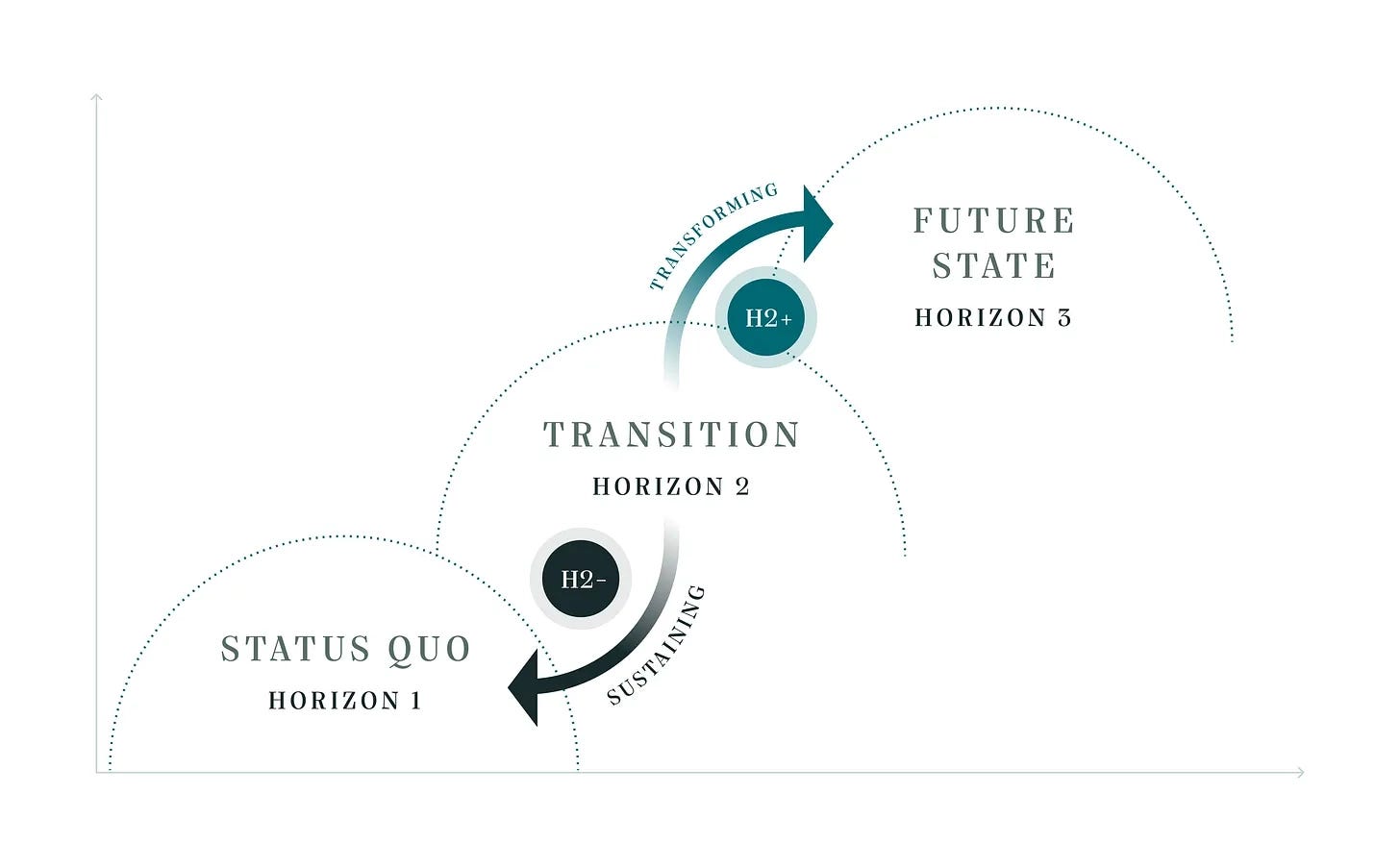
Fair warning, I haven’t been able to unsee this diagram since Pahlka first introduced it. The concept is fairly simple: Horizon 1 is where we are, Horizon 2 is a transition process, and Horizon 3 is a whole new way of doing work. The question Hodgson, Pahlka, and Born are asking is: Are you doing H2- work (sustaining the current broken process) or H2+ (pushing to a new and novel way of working in the future).
For me, my bureaucrat friends aren’t even touching Horizon 2. There’s just keeping the current process running, which is solidly Horizon 1. But, if I’m honest, a lot of the work I’ve been doing is likely H2-; cementing a broken process via better tools versus actually coming up with something new and novel. I had an XO over a decade ago who challenged us to do more than just replicate the paper process on digits, and I think this is what he was getting at.
Digitizing paper products does move the system faster, but that could easily be just installing expressways to nowhere worth going. Sure, you accelerated the process, but you didn’t actually change it. It entrenches us in the broken system. I haven’t gone back through my original Downrange Data posts to do an inventory of which ideas were H2- versus H2+, in no small part because I don’t think I’m going to like the answer.
But when you don’t get a say in the process, is my fellow ‘company man’ colonel right? Is learning the broken process the rational move? For most people, it seems it is. Only a minority, lower down the chain and unable to change the overall process, build workarounds. Stormking Analytics has been pushing hard on this one for a while:
The workaround is the rational move of someone still trying to get the job done inside a system that wasn’t built for them.

I think this is some of what Repenning and Kiefer were describing with their firefighting arsonists metaphor.
The art is not preventing workarounds but seeing them as the signals they are. Bypasses are symptoms to look for, not the actual problem. And firefighting arsonists like me are people with the motivation to make change. We’re just expending too much of our energy in the wrong way. We preserve Horizon 1 instead of reaching for Horizon 3.
Your Organization’s TPS Reports
A data advocate got up in front of the commander’s conference I attended stateside last month. He called out the redundant software he’d seen at every installation. ‘32 different garrisons have all made 32 different versions of GEARS.’3 One on hand, he’s absolutely right, we cannot have 32 different versions of a workaround to solve the same problem. But I think we’re missing the point if every unit is making its own workaround. That’s an unambiguous sign our software and current process is utter shit.
It’s also a sign that the people doing the actual work aren’t empowered to fix it, or even to have a say in fixing it. The people who just embrace GEARS are all Horizon 1 people. The 32 plus people who coded all those work arounds are Horizon 2 types, but most are doing H2- work. So were the people who got the contract to code GEARS in the first place, which is a huge part of why it sucks. It feels like the paper process, where a binder goes around from desk to desk, each time gathering dust and wait time as it idles for stamps or more signatures. It’s just digital now, sitting in virtual inboxes instead of wooden ones. And because it’s an army program it only gets updated once every couple of years, with only the slightest of customer input.
In most of the organizations I’ve been in, the guy at the top doesn’t even use GEARS. Typically, the front office still prints everything out and puts it in folders with coversheets. I don’t think there’s a better visual impact of H2- work than that: a stack of plain blue folders filled with paperwork awaiting a commander’s hand signature.
Finding Horizon 3
Back in 2023, I started this whole data effort arguing we need data savvy commanders. I still think this is key for the military. Commanders have outsized control, and as I’ve argued elsewhere, they are too often the parking brake of a formation.

If the commander wants folders, he gets paper folders. If the commander wants his PowerPoints — one sided, of course — then everyone screen grabs their tables and pastes them onto the slides that are inevitably not updated in time for the brief.
It’s a commander’s job to chart Horizon 3 for this formation. Too few do unless they have to. So why does anyone?
A recent conversation with a friend helped me see why so often fires is the avenue to that third horizon for army formations. It certainly was for the 18th Airborne under commanders like GEN Donahue.

I think the impetus can’t be ignored with fires we’ll die on today’s battlefield if we don’t change. We need to share data and fight with cheap sensors and strike at a speed the old system just can’t sustain. Once fires manages to sneak data’s nose under the tent, the rest of the Horizon 3 camel follows.
There are still plenty of senior officers who don’t get it. When a peer recently tried to brief a command on the progress deploying cheap sense and strike forward, the senior operations colonel had the gall to suggest that learning how to incorporate drones into their operations could potentially detract from their readiness. Solidly Horizon 1 thinking. These are leaders who’s ignorance is tragically going to kill everyone but themselves.
I think Horizon 2 undergirds all my efforts here in the Substack. My best work, the things I’m still most proud of are 2+. My cheap mass paper and the posts that it spawned and my Where Data Meets Gains series are solidly 2+. They sight the horizon and demand the change we need to achieve something new. They both have drawn a fair amount of resistance as well. The number of people who still try to argue that drones haven’t changed the character of war boggles my mind. And yet that number is probably dwarfed by the number of officers who refuse to believe I don’t run. Or do bench. Or curls.
Generating Velocity
Back at last month’s commander’s conference, the data briefer was pushing the virtues of Vantage as a platform for data, telling all the commander’s assembled we already had access to the system from their position.
I got a chance to take the microphone, so I started by explaining that while all us commanders assembled had access to Vantage, that didn’t mean we got access to the data we needed. All we’d been given was the standard ‘commander’s view’ which didn’t give you much more than the fitness scores of our formations.
‘I’ve only got 17 soldiers in my formation. I can keep that straight with a notebook’. When challenged about access to real garrison data platforms like eMH, I was able to get him to concede the data simply wasn’t in Vantage.4 Only four of us assembled knew that before we walked in the door.5 I took the chance to ask our headquarters a question, ‘Given we’re all stumbling around trying to figure this out, when can we get some sort of data clearing house where we can share what works and what doesn’t and ask for what we need?’ I was asking for a shared community for all the Horizon 2 and 3 teammates, where we could exchange ideas and challenges.
The communications civilian, who ostensibly has been working this issue for over six months, went on a lengthy and winding answer to describe his efforts to create one. I retorted with just a single one-word question, ‘When?’
He didn’t know. ‘Soon’, was the answer we got from the commander. Soon is not a date.
But then maybe that’s not the real answer. After all, forget AI, we can’t even do algebra yet. Collectively we’ve been pushing H2- work. In the blind world of Horizon 1, we few are the one eyed kings. But it’s not transformative.
Hogdson’s ‘horizons’ framework aligns very well with a professional developing tool I stole from a friend: Hudak’s pyramid. Designed as a tool to mentor his officers, I’ve use it with my teams today. Each layer of the pyramid represents the volume of your effort, and the baseline you need to set to move up.
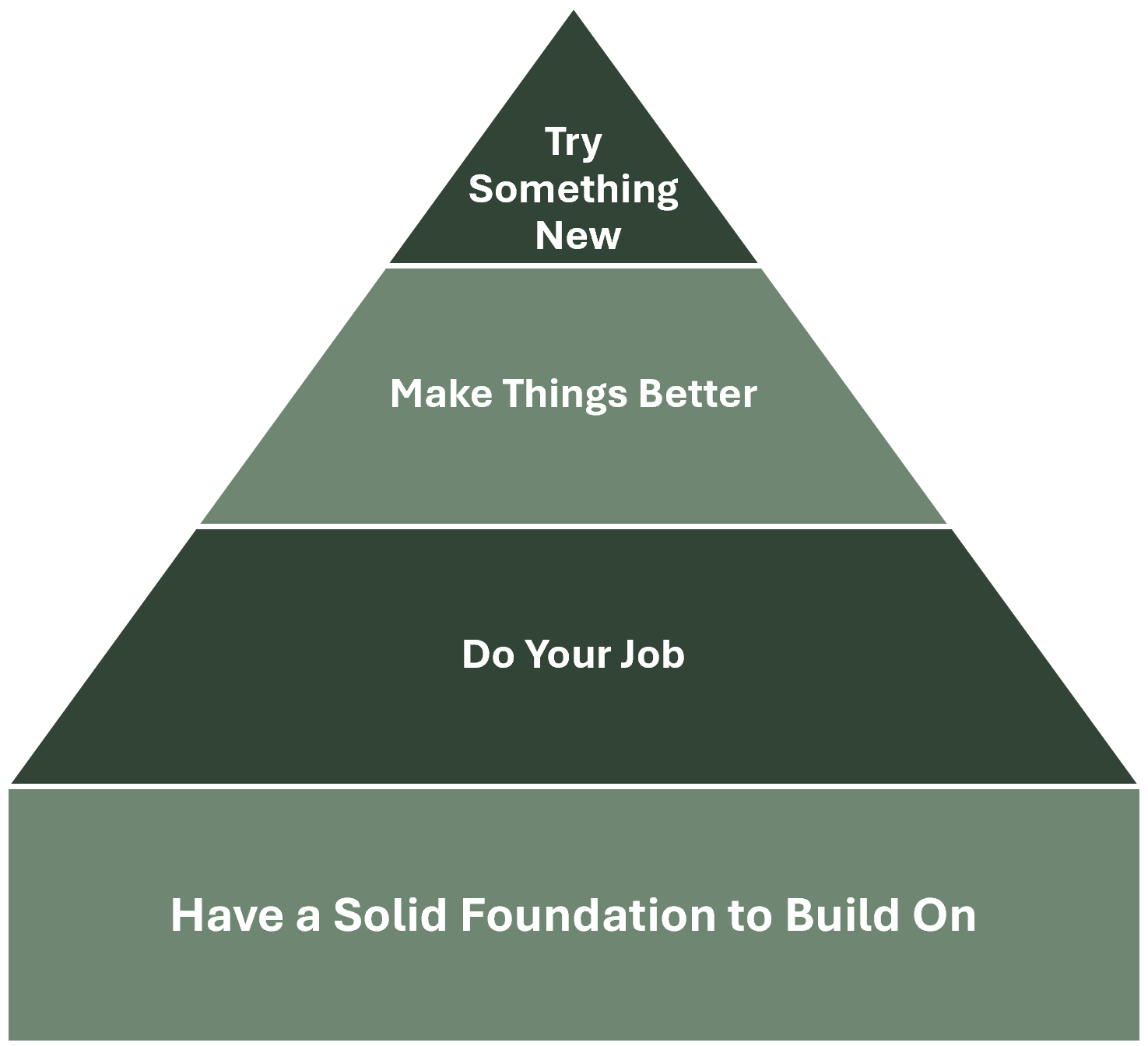
Hudak’s foundation is the culture, character, and values you bring to the team. One insight from you can draw from Hudak’s pyramid is it’s hard to innovate when at least 50%+ of your calories are taken up just being doing your job. This is where my bureaucrat peer isn’t wrong. Just learn the existing Horizon 1 system.
It takes a lot of energy to try and innovate, especially in a world where this takes precious time many of us simply don’t have. I still think data and digitization are key steps to buying back that time. But thanks to Pahlka and Hodgson, I cannot unsee the horizons now. With each new effort I have to ask myself, am I helping entrench an existing system, or revolutionizing it?
I also realize we’ll never get beyond that first horizon if we don’t find ways to minimize or circumvent the earthbound people. That means finding a way to change those bureaucrat’s incentives. For me that still takes fixing our commander problem. I’m hoping Hogdson’s paradigm helps me sway some opinions.
I continue to advocate replacing ‘Once and Eagle’ with Pahlka’s ‘Recoding America’ on every command reading list.
Hat tip to Kelly Born at the Packard Foundation for introducing it to her.
Footnote: A classic army backronym, Global Electronic Approval Routing System is an absolute shit system for approving and signing paperwork. Every job on the planet does this ‘sign and approve paperwork’ thing, and yet somehow there does not seem to be any good client-side tools for this.
Enterprise Military Housing. The database actually comes from the navy apparently.
I owe a huge thank you to everyone who reached out after Firefighting Arsonist to help me crack at the problem. I would not have known this without you.
I was introduced to the 3 horizons method by the Google rapid innovation team when we were crashing on a talent management project and I wish I'd learned about it earlier! It very much challenges the linear planning frameworks and operational design we were taught, and focuses on adding real purpose to the incremental change rather than letting us take the easy out of making an incremental change and calling it done. Great article!
The problems you're describing aren't new, and they're not unique to the military. This same pattern has played out for decades, in and out of uniform.
Horizon 2-, 1984 style:
As a young GI in 1984, our Air Force base in New Mexico got its first Zenith 100 with a hard drive. Three of us, an enthusiast (SSgt Blair), a Computer Science major (MSgt Moore), and me, a SSgt with a Computer/Communications AFSC, decided to automate a huge chunk of daily manual work and the enormous checklists generated during exercises. It cut what had been up to 12 hours of hand calculated paperwork per aircraft generation down to about 30 minutes a plane.
The program spread like a slow-motion virus, copied floppy to floppy, carried from base to base by whoever transferred out. Within two years, everyone had a version, and everyone was modifying it to fit their own needs. I once saw a copy that had stripped out all the useful features just to do the bare minimum. That's Horizon 2- in a nutshell: every base building its own hacked variant, entrenching the same broken underlying process instead of fixing it.
Horizon 1 pushing back
The real obstacle wasn't the tech, it was an O-6 from the inspection team who refused to let us use it because he couldn't personally watch us hand calculate every number, so how could he trust it? I nearly said something I'd have regretted; thankfully MSgt Moore stepped in and talked him through it, because my sarcasm toward people who don't understand computers tends to leak out at the worst moments. He still didn't approve it on the spot, but we had sign off the following week. That colonel simply could not accept anything outside Horizon 1. Paper and hand calculation was the system, as far as he was concerned.
A late, partial Horizon 2+
It took the Air Force until 1995 to field an official system that actually worked, and even then, only for stateside F-16 bases. Years later, I talked to an F-15 maintainer who'd found his own workaround to bypass the official generation module in CAMS, because it still didn't handle their aircraft. So even the "official" fix just pushed the workaround problem down a different runway. I'd like to think Horizon 3 eventually arrived for them. It did for me. I moved on to better things.
The civilian side: healthcare's version of the same wall
I've spent years on the information side of healthcare, and the same three horizons show up there just as clearly. To this day, no one has a truly holistic view of a patient: acute care, hospital visits, chiropractic, dental, mental health, physical therapy, and wellness all stay siloed. It's been attempted repeatedly and never sustained. First it was older clinicians distrusting computers. Then it was well intentioned privacy regulation that made data sharing hard to build around. Every stakeholder group went its own direction, and by the time data sharing agreements became feasible, the underlying systems had diverged so far that interfacing them was slow and expensive, with no billing model to pay for integration work that mainly helps early diagnosis, while later stage care needs it least.
In 1997, at St. Alphonsus Medical Center in Boise, we tried anyway, a genuinely H2--- effort, stitched together largely by hand, with about 100 patients who'd agreed to participate as long as we masked their identities. One of the oncologists reviewing the combined data wanted to speak with a specific patient. We couldn't give him her name directly, so we contacted her and connected them ourselves. By combining data sources that normally never touched, he spotted a trend pointing to early ovarian cancer. It was caught and treated.
Almost twenty years later, we still don't have a comprehensive system to do this, not even inside fully integrated delivery systems.
The point
The path to Horizon 3 may be expensive, maybe even prohibitively so in some cases. But that's not a reason to stop reaching for it. If we actually document the steps from where we are to where we're trying to go, we hand systems engineers, data analysts, and programmers a map, not just a workaround to copy onto the next floppy disk.