


Being a dad has objectively made me a better person, but also a smarter leader.
Take tonight for example. My wife homeschools our kids and today was azimuth check day. Both our children took a battery of writing and math assessments to measure their progress and identify their challenge spots. Over dinner, I asked my daughter how her tests had gone and her face screwed up in confusion.
‘Tests?’ She asked. She was right to wonder; the word felt wrong as soon as I’d said it. My wife quickly intervened, correcting with ‘He means diagnostics.’ That simple reframing revealed my error instantly, not just in my question, but in so much more.
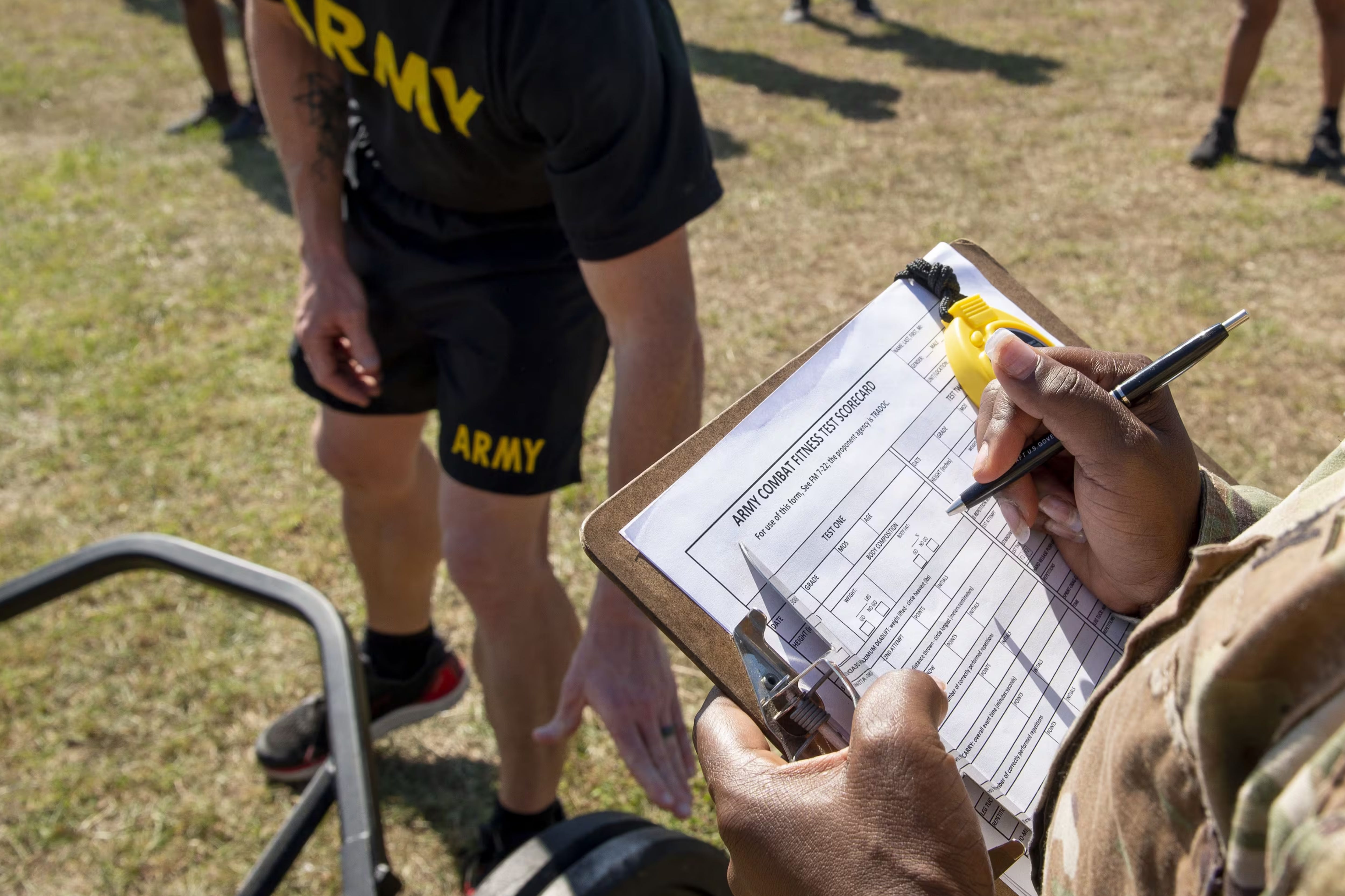
The focus of this month’s ‘Garrison Gains’ workout was the absurdity of relying on a single test for one’s fitness. I explained to the assembled soldiers how the original concept of the Army Combat Fitness Test (ACFT) was not something you train specifically for, but instead an assessment of soldiers’ overall fitness.1 Soldiers were supposed to get a solid baseline of readiness they could rely upon, not on simplistic goals like pass/fail. But army’s gotta army, so of course the AFT has become just another thing we train to pass. It’s right there in its name: It’s a ‘test’.
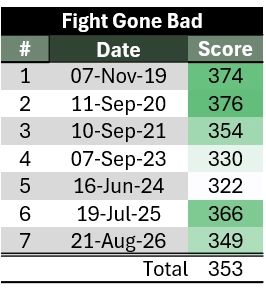
For August’s Garrison Gains, we were doing Fight Gone Bad (FGB), which I’ve been doing about once a year since 2019.2
I fell in love with the workout back in 2009 for a few simple reasons:
All the movements are realistic.
The weights are very approachable for just about anyone.
The scoring was very familiar to those brought up in an Army Physical Fitness Test (APFT) world where 300 was ‘max’. If you score over 300 on FGB, you’re doing pretty good.
Most importantly, if you can’t do any of the movements then you need to get with a PT or a strength coach, because those are holes in your swing.
This is the exact same philosophy behind the Shinobe and Hoplite workouts. The level 2 goals are great, and the level 3s are an accomplishment anyone should be proud of. But if you can’t do any level 1s, that’s a clear sign you have a deficiency. It might be a therapy challenge, or a knowledge or technique one. Regardless, long before you even think of wasting your time on bench or curls, these deficiencies should be your primary targets. Shinobe and Hoplite aren’t tests. They are diagnostics.
Diagnostics were on my mind when I followed up with my teams back in 2021. Despite COVID, we had rolled out the ACFT that fall. I never asked ‘What was your score?’, despite most soldiers anticipated me asking exactly that. Instead, I wanted to know, ‘What was your weakest event?’
The question caught just about everyone off guard. The purpose wasn’t passing a test, it was finding out where you could improve.
Or maybe where you shouldn’t worry over improving. I had a team sergeant admit, to his own embarrassment, that his deadlift was his weakest event. But it didn’t surprise me at all. He was the oldest guy on his team, and when I asked him why he was worried about his deadlift, having clearly exceeded the standard, the best he could offer was because that was the thing which was holding him back from a ‘perfect score’. But that’s a test mentality.
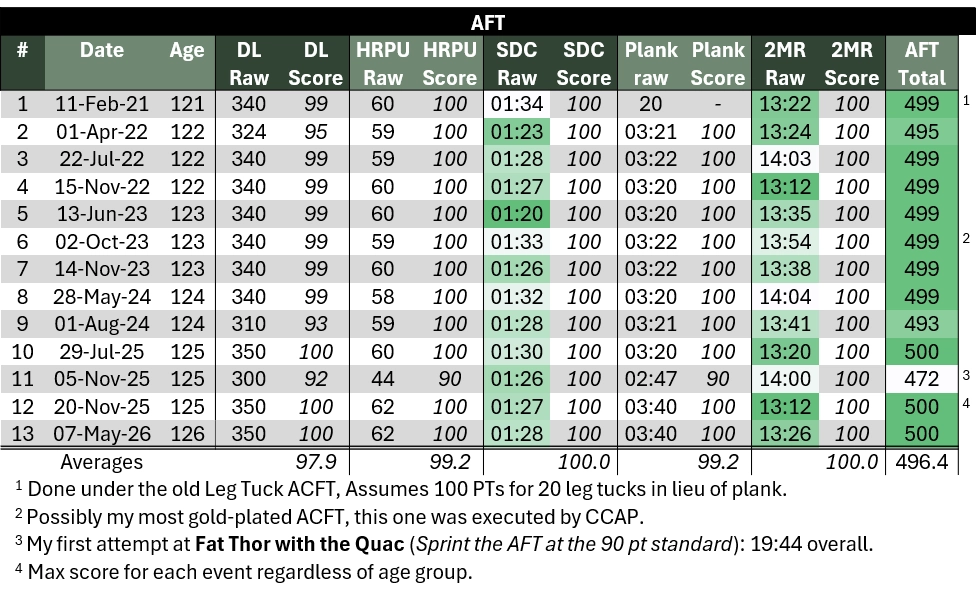
A diagnostic mentality would help him see he can do the job he needs to — meet the standard — and so pursuing a deadlift ‘perfect score’ put him at a higher risk of injuring himself for little payoff. I advised him to accept his age and find a new goal to chase.
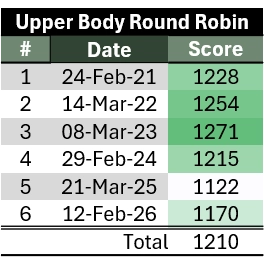
I do four diagnostics a year. Previously, at least two of them were AFTs, though starting this year it’s become the CFT in the spring (Q3) and the AFT in the fall (Q1).3 In the opposite quarters I do two diagnostics: The Upper Body Round Robin in the winter (Q2), and FGB in the summer (Q4). Coupled with a smattering of repeat WoDs throughout the year, I get constant feedback on my readiness and the things I need to work on. Of note, both the UBRR and FGB have no max score. Instead of just getting the score you need and getting up, you push yourself to full time.
These diagnostics do more that just help me focus my fitness planning; they make sure I stay ready. This year ready meant a no-notice Combat Fitness Test and my third climb up Mount Fuji.

I don’t know what next year’s ready will be. But I know a test won’t help me get there. Diagnostics might.
The old single measure tape test was just that: a test. It didn’t tell you what to work on, nor how to improve. It didn’t diagnose anything; it only gave us all a number. It told us nothing about what our soldiers’ could do, or what they couldn’t.

The InBody scan was better for me, since it told me details about my bone and muscle mass, as well as water I was carrying. It helped me diagnose my asymmetries. Of course what really mattered was what my 540+ ACFT score told me: Don’t worry about my tape test at all.
Our new waist-to-height ratio (WtHR) test is yet another test. It doesn’t diagnose a nutrition problem any more than it tell us something useful about our psychical readiness. It’s not a diagnostic. My 53.9% WtHR score doesn’t tell me much beyond I have less than .5” to keeping me from getting flagged. So far, all the new WtHR scores have told me is there might be a correlation between higher AFT scores and higher WtHR numbers.
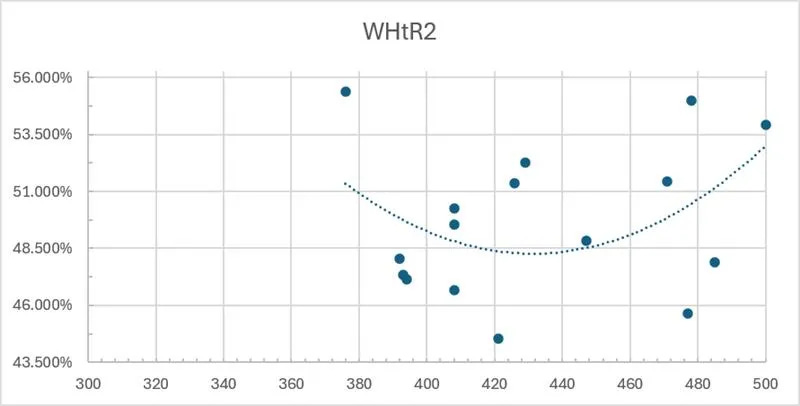
That’s a small data set. I’m certainly curious to seeing what the numbers tell us at an Army scale.
But those numbers still won’t tell leaders what to work on. Do your soldiers have a diet challenge? Is stronger going to make them bigger? Should we as an Army be aiming for measurably weaker soldiers with better WtHRs? What makes a soldier ready?

Those are decisions leaders must make. My advice, for what it’s worth: find good diagnostics. Tests are for the amateurs. Tests only tell us whether someone passed a line we drew. Diagnostics tell us where to coach, where to redirect away from bad goals, and where to focus next. The difference matters because leaders need more than good scores. We need better people.
Since shorted to just the Army Fitness Test (AFT).
For those unfamiliar with FGB, it’s this Sunday’s Weekly WoD.
I married into a family of delicious food, so I do the AFT the weekend before Thanksgiving to enable a glorious holiday season. I’m gluttonous all the way until January when I tighten my belt and get back after healthier eating, with plenty of time to do so before the spring test.
You make a fair point that the test isn't the diagnosis — but for the many soldiers who just need to know where they stand on the new 0.55 WHtR standard before it bites them, having a quick reference helps. The army body fat calculator at armyptcalculator.com covers both the new waist-to-height standard and the old tape test, which is useful during this transition.
In the world of human performance, there is a stark difference in meaning behind diagnostic and test. What you are describing is still testing. Testing measures output capacity, but it does not tell us why someone has (or lacks) capacity. Diagnostics show us why. A HP professional would look at your team SGT's deadlift weak link and automatically want to run a diagnostic to figure out why it is his weakest event, as it will likely point to something that needs to be worked on that will have carryover into many other physical job related tasks. Does he have a spinal injury, motor control dysfunction, etc. Just chalking it up to age and saying the score is good enough and not worth the risk is the complete opposite of a diagnostic. Just my thoughts as a military HP guy.