


We aren’t where we need to be as an army, but at least we’ve stopped ignoring the problem. The Russians and the Norks all have more experience fighting with and against drones than we do. But at least the antiquated four-stars who briefed my pre-command course in 2024 have all gone extinct now.
Good riddance. B.H. Liddell Hart was right about how hard it was to make room in the military mind for a good new idea. But it was Max Planck who identified the fastest way to effect the necessary changes:
A new scientific truth does not triumph by convincing its opponents and making them see the light, but rather because its opponents eventually die and a new generation grows up that is familiar with it.1
That is not to say every argument you read in NatSec blogs today is in good faith. There are still folks out there tilting against strawmen to argue that ‘drones will not replace infantry’ — No one is saying they will. But at least the false idea that Ukraine’s and Russia’s use of drones is just some flash in the pan ‘positional warfare’ problem has gone the way of the dodo. Losing a $20 million dollar radar to a lawnmower has a way of sharpening the mind.
But the US military still doesn’t know how to fight with the new tools yet. Candidly, I don’t think anyone does. We are solidly in the FAFO space. This is incredibly uncomfortable for a lot of military leaders. I’ve seen officers of all ranks frozen like deer in headlights while they wait for the published doctrine to guide the way on cheap drones. They seem to have forgotten doctrine is typically one of the last steps in the process of DOTMLPF (doctrine, organization, training, materiel, leadership and education, personnel, and facilities).2
The reality is we often get the materiel first, but no one really knows how to use it. That takes leaders willing to innovate — to fuck with it. Change can also come on the heels of a bunch of body bags. Imminent death tends to sharpen the mind too.
Once the blood starts spilling, people fumble around grasping at new tools until something works. Whenever anyone finds a successful way to attack or organize, they try to propagate it out, often much slower and more informally that we’d like. New tactics or tools often start showing up in personnel followed naturally by our training and education. Only then does the innovation find its way into our doctrine, which will in turn drive facility changes, often the slowest process. If you think acquisitions crawls, try MILCON.3
In my opinion, the best way to accelerate the process is to empower and select leaders who drive this change. I’ve written about it — a lot.
But picking winning thoroughbreds can be uncomfortable and risky, not a gamble many people are willing to chance. So, the next best thing you can do is not pick slow horses.

When it comes to cheap sense and strike, I’ve found another tell you’ve stumbled onto a lame leader: They use ‘group’.
Is It Bigger Than A Breadbox?
The army needs to ditch the ‘group’ classification for drones. The services have been using this 1-5 scale since 2011, and it has failed to drive the innovation we need to our equipment and our doctrine. I argue ‘group’ has played an outsized role in why we’re behind our adversaries on this tech because what ‘group’ a drone is doesn’t really tell us anything of value about how to fight with it.
The ‘group’ system, laid out in Joint Unmanned Aircraft Systems Minimum Training Standards, focuses overwhelmingly on how big the platform is, or how much it can lift. They pivot number is maximum gross takeoff weight (MGTOW) the ϋber nerds out there.
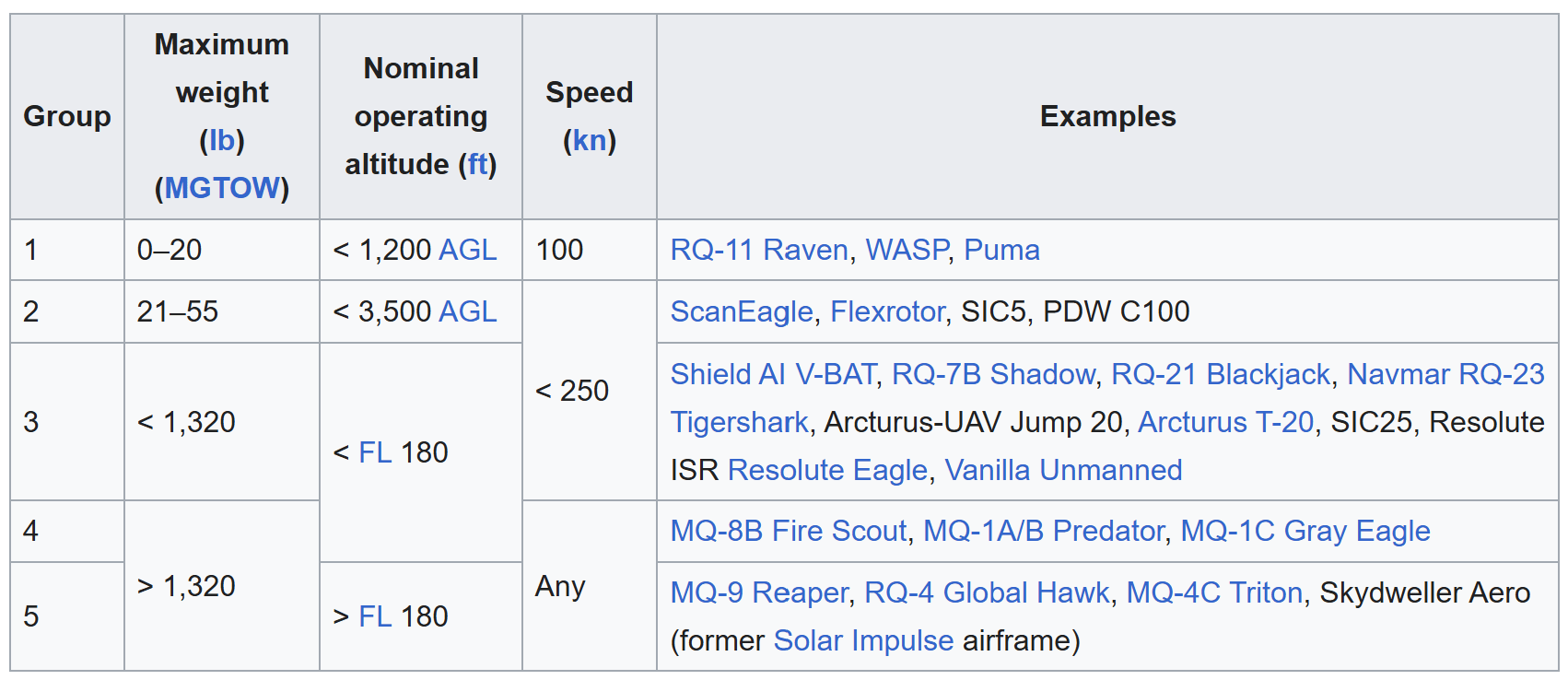
You’ll quickly notice we don’t describe any other platforms this way. Not helicopters, nor planes, nor boats; nobody uses the mass — displacement or otherwise — as the primary differentiator for our other systems.
‘Group’ is the ‘Waist to Height Ratio (WtHR)’ of cheap drones. Neither measure tells us anything about the real capabilities of the thing they are meant to describe.4 Both are vapid cosmetic variables.
Instead we describe most platforms via their capabilities, not size. Bombers do a different mission than a recce aircraft, just like ice breakers have little in common with cutters. Even platforms that are nominally the same size may have completely different payloads: electronic warfare birds have completely different roles that combat air patrols.
Instead of ‘groups’ smart leaders talk about cheap sense and strike by their utility. What gaps can they solve? Gaps are the most important drivers of new DOTMLPF.
Justin McIntosh details how critical this is in one of his recent posts:

The work of developing military technology starts before anyone begins designing solutions. It must start with operational gaps. Looking at the programs above, along with a bevy of others, from IVAS to the Trump-class battleship, the recurring failure is allowing technology or expanding requirements to displace the original battlefield problem. The solutions to these gaps should provide a measurable advantage to troops. If they do not, they are just interesting innovations without meaningful operational utility.
‘Gaps’ are not a uniquely American way to examine military problems. I was lucky enough to catch Dr Oleksandra Molloy present at the Australian Strategic Policies Institute (ASPI) during my internship there last year. There she introduced me to just a handful of the gaps the Ukrainians are filling with cheap sense and strike, or as Molloy puts them:
uncrewed and autonomous systems across air, land, and maritime domains (collectively ‘UxS’).
In her recent cross-post with retired Australian general Mick Ryan, she lays out the challenges of adapting to these new tools, from the tactical to the strategic level.

Crossing The Gap
What are some of the gaps leaders should be trying to fill with cheap sense and strike?
Sense Electro-Magnetic (EM) sources in their immediate area — both piloting and jamming
Observe nearby area (2k) via visual and non-visual spectrums
Strike targets within 40km. Then out to 100km. Then 150km. Work at all those ranges despite EW jamming.
Distract opponents via decoys and deception.
Move logistics up to X kilograms from A to B via air. Then via ground. Then do it all again to move casualties.
Emplace scatterable minefields and record locations. Assess and identify the same in potential enemy minefields.
Autonomously target and close kill webs with humans on and off the loop.
Draw power from local sources to improve longevity.
Serve as a mothership each of the above.
Now do all the above in the water. Then under it.
Counter all of the above.
That’s far from an exhaustive list. For more ideas, check out Olena Kryshanivska’s substack ‘Ukraine Drone Brief’ for an impressive run down on where the tech is today.

Then remember effectively none of it existed just four years ago. Most of it will be replaced within the next two. There is a whole ‘Red Queen’ race being run right now, one too many western military leaders are ignorant of.
When you hear a leader begin by describing drones in terms of ‘Group 1-2’ or ‘Group 3’, they’re telling you they don’t know what to do with them. They are ignorantly telegraphing they don’t think about how to fight with them. They aren’t asking what unique way can they employ them or how they can augment their soldiers with them. They aren’t asking how attritable is this new system?5 At best all they’re asking is how heavy it is.
Ditch The ‘Group’
There are clearly hurdles slowing the US military’s adoption and innovation with these technologies. The acquisition and FYDP obstacles are already well documented.6 The latest AUTOMWARCOM is an attempt by our department to move the ball forward. But I am skeptical. I’m not alone.

As Molloy notes in her post:
The sheer volume and diversity of UxS now in play – from soldier-carried quadcopters to networked loitering strikes – means that without structural change, these platforms will either be under-used or add to organisational confusion.
For me, much of the cheap sense and strike technology is less like a new corps and more like a new radio. Big platforms with narrow applications — think tanks or air defense platforms — were given corps to steward their development.
But radios are a ubiquitous tech — everyone uses them. Sure, we have a signal corps, but they manage technical knowledge and only the most significant backbones of our comms technologies. Radios, meanwhile, have made their way all the way down to the fire-team level. You’ll notice we don’t group radios by their weight, but what they can do.
I see most of this new cheap sense and strike, Molloy’s UxS systems, penetrating every formation from the cavalry scout team to the logistics convoy. I frankly don’t envision a formation that can’t benefit in some way from these tools. I certainly can’t envision one that won’t be targeted by them.
Returning to Molloy, she sees the need for both a top-down steward and ground level leader innovation.
These pressures make organisational reform a warfighting requirement rather than a technology-modernisation option. Military organisations need both specialist UxS organisations capable of developing tactics, integrating emerging technologies and generating concentrated effects, and appropriately equipped conventional formations with organic access to drones, counter-UxS systems, electronic warfare, and technical support.
~ ~ ~
Over 15 years ago, while trying to learn as much as I could about cyber, I adopted a simple test for any guest speaker. Could they setup their own PowerPoint brief? Anyone who needed a tech’s help to do this basic task wasn’t worth listening to on cyber.
‘Group’ has become the same for me today. Any leader who talks about cheap sense and strike from the ‘group’ lens and not the gaps, generally has no idea what they want. Instead, that leader is telegraphing to you they are not getting ready.
You might find DOTMLPF with another P for ‘policy’ or an ‘I’ for ‘interoperability’ at the end. Like the ‘C2/4/5/6?/ISR’ initialism, this one seems to grow like a kudzu when you aren’t watching.
MILitary CONstruction.
The numbers on WtHR have only gotten worse as we’ve added to our unit’s dataset.
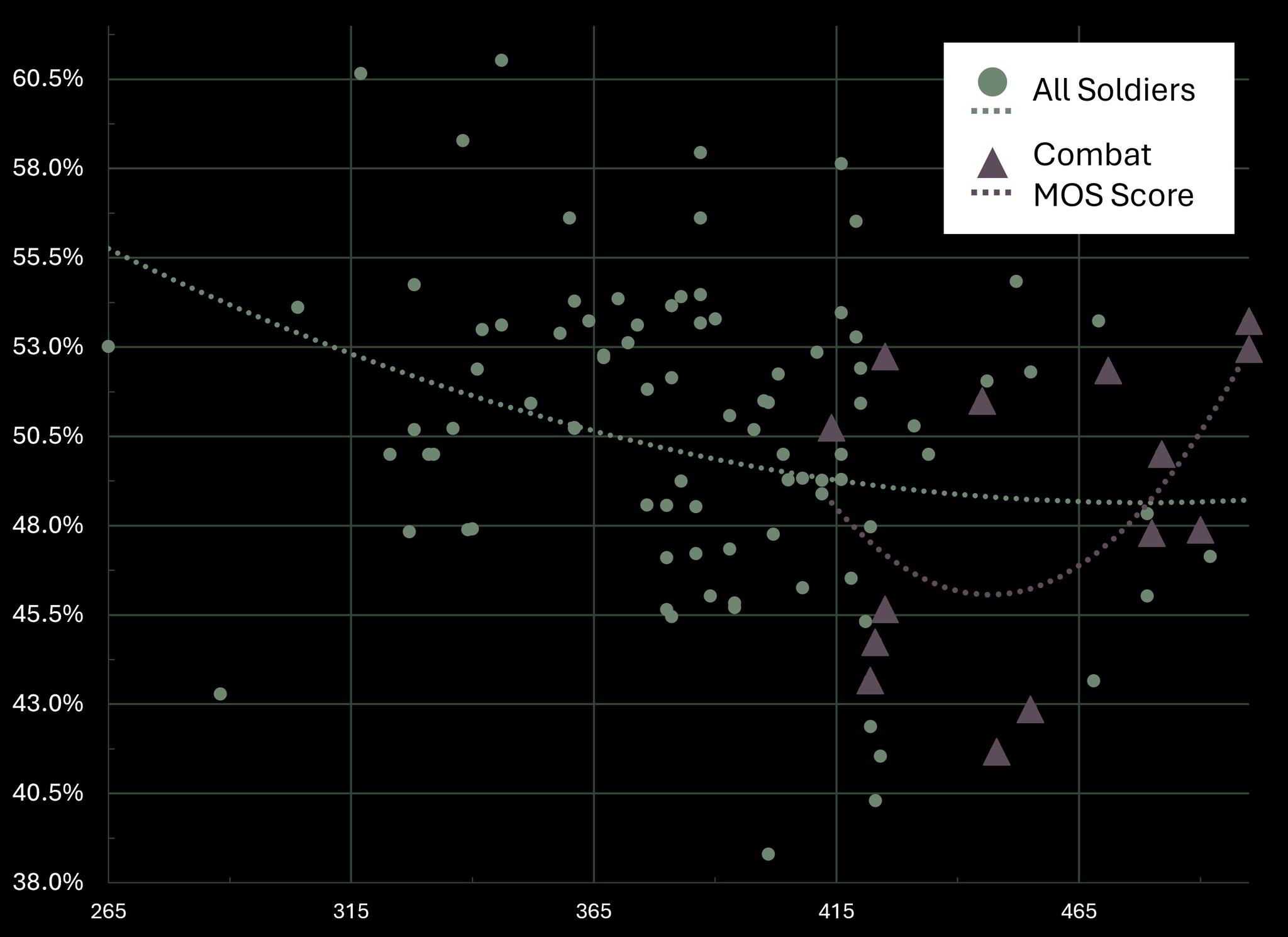
Assessing on the combat MOS standard shows a correlation between increased scores — objectively measured capabilities — and increased WtHR. Purple diamonds below are those who met the Combat MOS standard— male 70 points and above. While I’d argue the 70-point standard is not anything to brag about, it does represent clear and objectively measured power, speed, and endurance.
Shout out to all of us who wasted hours of our lives in Iraq and Afghanistan searching for overpriced lawnmowers that got lost.
Future Years Defense Program, or how the army plans to spend money over the next 7 years — the next two are budget years, and the five after FYDP.

Perhaps not quickly, but I think we are trending in the right direction on the training and education piece. MCOE is is integrating UAS into the MCCC (soon to be ICCC) curriculum, so the CPTs heading into command right now have at least some exposure to thinking about how to employ SUAS for both sensing and striking