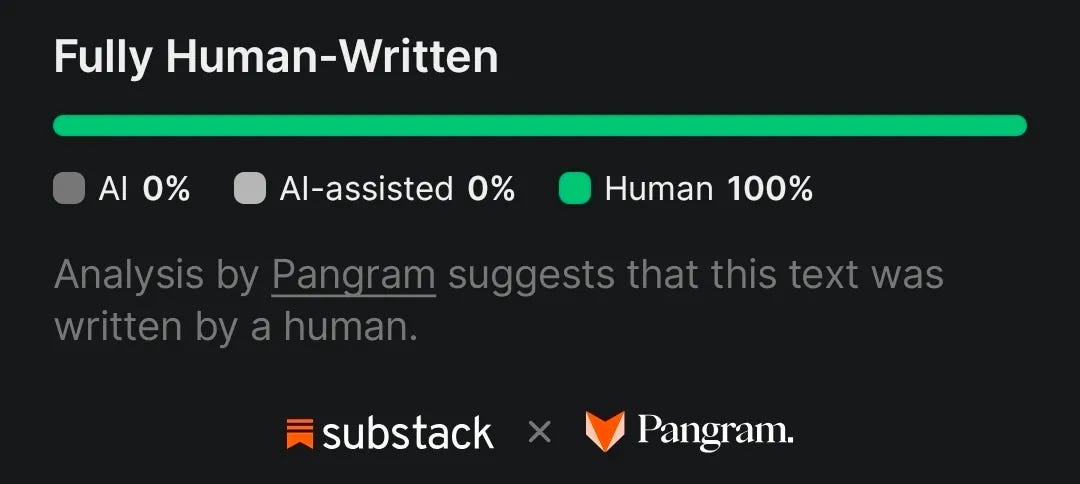
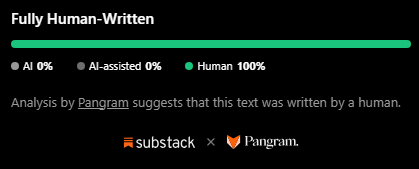
At the end of last month, Substack rolled out a tool in partnership with Pangram to help readers see how much of their favorite substacks appear to be AI-drafted.
The tool currently only works for posts uploaded since 26 July, which I only just barely made the cutoff for. Perhaps unsurprisingly:
Despite those results, I’m not against AI. I’m not a doomer, nor one of the content creators who loudly proclaims their ideological aversion to AI.
For starters, calling it all ‘AI’ as if that’s a single monolithic thing isn’t helping anyone. Every human question seems to turn on ‘It depends’, and AI is no different. For me and AI, the questions are which model for which purpose. I use about a dozen models under Stable Diffusion for image generation. I use GenAI on work computers to help draft radio scripts and to parse long PDFs. I don’t use Grok for anything. These are all different models for different reasons. The habit of lumping all use cases and tools into a single bucket isn’t helping us find a way forward.
Regardless my stance remains relatively unmoved since I first stumbled upon it back in 2009, when my wife and I stood in front of the AI apocalypse display at the SciFi museum (the Museum of Pop Culture since 2016). In a hall dedicated to Sci-Fi tropes, one whole exhibit was focused on the robot / AI apocalypse. It showcased films like The Lawnmower Man, The Matrix, and The Terminator alongside books like Asimov’s ‘I, Robot’. Even Georges Méliès’s 1897 ‘Gugusse et l’Automate’ and the 1927 Metropolis got nods as early automaton science fiction.
As a species, we’ve been anticipating and carving out the various edge cases for AI since at least the Hebrew Bible’s golems. Long before a chess algorithm could beat a kindergartner, we dreamt up the Mechanical Turk. We have thousands of years of foresight to work from. So, when it comes to AI doomerism, my stance is simple,
‘If after thousands of years exploring this idea, if after hundreds of cautionary tales we still do it, if we turn on Skynet, well then I welcome our robot overlords.’
What I don’t use AI for
First and foremost, I don’t use AI to write. The why here is very simple; Brad Stulberg said it better than I ever could (thank you David Epstein for surfacing it for me):
The main reason I write and lift weights is because a technology company can’t design a robot that can make me feel what I feel when I write and lift weights.
Robots have been outlifting me for decades, and Boston Dynamics can certainly out-agility me. But I’m still headed to the gym this afternoon. That’s because gains aren’t transferable; you gotta get yours.
The same goes for my writing, which is really just distilled thinking. I’m not writing for money. This Substack is still free. I’m gonna need to move a lot more stickers if I want to supplement my income.
I write because it helps me think. It makes me order thoughts, test and retest arguments. In the way Nate Silver suggested, I’m always writing.
I actually do my best writing in the swimming pool. I’ll spend my entire set worrying over whatever popcorn kernel of an idea was stuck in my mind when I hit the water. I started leveraging this cheat code during my undergrad coding days, when I couldn’t get a program to compile. The only challenge is there’s no pen and paper to capture your ideas with in a pool. There’s not AI either. Some ideas never manage to get out of that pool. C’est la vie.
Despite the supposed AI giveaway, the em dashes in this Substack really are mine. I owe author and youtuber John Green for clueing me in to their proper use: Which is Correct? — or – ?
I write in a very conversational style, with a lot of asides. These can sometimes nest, and before em dashes I found myself with sentences that had more parenthesis than a calculus final. Em dashes are an elegant way to break off part of your sentence, so I’ve stuck with them despite their supposed AI marker. Trent Lythgoe — who probably wishes I’d stop associating him with my poor grammar — has a great guide on how to use them, as well as all the other punctuations:
How I use AI: As an Illustrator
The logos for this Substack were born from running a bunch of early bare bones concepts into Stable Diffusion and seeing what it spat out.
My first use of AI for graphics started the year prior with Dall-E.1 Work needed an image for a PowerPoint and the guy charged with making it couldn’t seem to find a good example of what he wanted on the internet. I went outside to my car and whipped up what he wanted on my phone in 10 minutes, because in 2023 you couldn’t get on any AI website from an Army domain.
Dall-E Caught my attention more than ChatGPT had, and I was trying to understand AI better. I was listening to good podcasts on AI but most of what Practical AI was introducing was going right over my head. I found I learn better with projects, which worked out since I needed a way to break up the monotony of 10,000 words of text.
I downloaded Stable Diffusion to my home computer, which allowed me to work with it off-cloud. After downloading a few models and LoRAs from Civitai.com and a week of learning, I had about a dozen images to use. All of this was free, run on my weak little GTX 1070. It was slow, but I wasn’t working for realistic photos, just abstract art which encouraged readers to fill in the gaps themselves. Overall, I’m still not disappointed with the effort, and OP Black Ditch was subsequently published in Special Warfare magazine.
About a month later a peer challenged me to redo Iron Maiden’s Trooper.
The results are still kicking around offices and headquarters. It took over 1,000 iterations, and I laugh at how many dead ends I stumbled down along the way. But I also have to recognize those dead ends are essential to the learning process. It’s the same thing today’s AI does, actually; runs down dead ends, tweaks and adjusts, then runs down more dead ends until the product starts to refine. LLMs just do that at a speed unfathomable to humans.
I used Stable Diffusion again for the header graphics on my next FICINT effort, a short story examining what happens when faith in AI transitions into just faith. The first two chapters were highlighted here and here, though candidly I’m most happy with the third.
These were made with more LoRAs and models for Stable Diffusion. I went into the project knowing broadly what I wanted to create: illuminated texts as an homage to the Canticle for Liebowitz, which was the story which spawned the structure. The images are real world things like a Bradley Fighting Vehicle and Krizhevsky’s original GTX 580, mixed with the imaginary.2 The fanciful prompts gave me future Taiwanese drones that could swim, run, and fly as well as the Monitor sarcophagus, which inverts the traditional centaur image for one where AI hacks the malleability of the human mind. We become the tool, not the AI.
In all the above cases I started with an idea and a prompt, but the product is a collaboration between the AI and me. This is how I think AI use should be. As David Epstein discusses in his substack, using AI as a collaborator is a way to produce superior products. Just slopping your way through it produces a subpar product.
These days I mostly use AI as an editor for Downrange Data. Everyone needs an editor, and previously I was paying my wife to do the work. Candidly, I think she’s still superior to the models I’ve been using. But she’s a doctor, and when she’s not homeschooling two kids while also learning a foreign language, she’s also seeing clients. I simply can’t afford her time anymore, certainly not for a Substack which doesn’t pull any revenue.
So these days, once I finish a draft, I port the post over to an AI (I’m toying with a few different models) and ask it for suggested edits. I still don’t trust it to do rewrites though, and I keep my original draft’s separate. This is primarily because LLMs tend to be tools of averages; averages which iron out the parts of my voice I most enjoy writing on my Substack. Academic articles just aren’t fun for me to write, but AI doesn’t love my style:
CoPilot: ‘You can keep one vivid metaphor—just not too many.’ Me:
My posts aren’t nearly as tight as when my wife edited them, but AI does a good enough job that I’ve only had a few readers poke me about my errors.3
How I use AI: As a Mentor
Another great way I’ve found AI helpful is in explaining ideas. You need to be a bit careful here or you can find yourself listening to a tool that’s been coded as a sycophant.
When I wanted code to simulate hundreds of generations to look at statistical outcomes, I turned to AI to help me code the tool. I’m possibly rustier as a coder than I am at statistics, as my recent runs on The Farmer Was Replaced() has repeatedly shown me. But I didn’t just AI slop the code, but instead then had the LLM go through the code with me and explain it. Between the two of us we managed to refine the code until it not only did the math I wanted, but I understood how it was doing it.
As I shared in my recent restack, we need leaders who are curious about the tools, who know what they can and cannot do.
Over the last year, I’ve listened to people brag not using AI tools as an attempt to justify why they were behind schedule. Another user bragged about how his team wasn’t using the AI tools in their Adobe subscription. This same team sees no issue with using the exact same stock photos the AI was trained on though. These people see a dividing line I don’t.
Regardless, ignoring AI seems ignorant to me. I don’t support the 21st Century Luddites who are trying to fight AI tools, but at least they’re doing something. I simply don’t see apathy as a strategy.
What I ask is which tool will help me with my product. It’s not about not thinking, writing, editing, or even lifting things. AI’s role for me is to help me see, test, or edit. The orginiator is me, and what I’m thing to create.
I don’t use AI to do the things I want to do. I use it to do them better.







Your AI editor quit on you at the next to last 'paragraph'. 😎 Always appreciate your writing & perspective.