


This post is a roll-up repost of the notes I shared as part of my campaign to get SW to take on the challenge of charting the future of the Green Berets. The ideas are mine, so they are far from gospel. I didn’t respond to most of the comments, because these ideas aren’t the point. The point is for the regiment, and SWC in particular, to take on the task of charting a way forward for green berets.
By all accounts SW has ignored the call, but I still think our regiment is ripe for a rethink. Perhaps SWJ or IWI is interested in hosting the debate we need to find our way forward.
All ideas below are just my chicken scratch; intended as much as sparks as their own ideas. What’re yours? Post them in the comments.
#1: THE GREEN IS THE CRITICAL PART.
The US military has a habit of ignoring our partner forces. I’ve been to plenty of wargames where green wasn’t even modeled. For those who don’t know, green is the color we use for our partners in a conflict. Friendlies are blue, enemies are red, and unknown or neutrals are yellow.
We didn’t get our green berets because of our relationship with our partners (the British Commandos gifted us our hats), but it’s why we should keep them.
Our military’s inability to focus on green forces is why Iraq, and in particular Afghanistan, ended as such abject failures. The same can be said about Vietnam.
But SF is different, which is why SF trained soldiers held their ground when the regular army trained forces melted around them. SF focusing on the green is why the Philippines and Colombia are held up today as examples of successful counterinsurgencies. Green is why Ukraine still stands today against the Russian invasion.
SF’s focus on relationships is why we have generational partnerships with not only these countries, but a hundred others around the globe.
SF will always be centered on our partner force, and every time we stray from that, we fail. Any future strategy which seeks to define green berets must have partners at its core.

#2: WE'RE GOING TO SHRINK AS A REGIMENT.
There will be fewer serving GBs tomorrow than there are today. We’re already shrinking as a regiment, with on average, one SFODA ghosted per company. We can’t recruit, never mind train enough GBs to fill the regiment.
This means whatever solutions or changes we decide on for the regiment, we must accept a smaller regiment. This is our reality. We will have fewer GBs. We will do less. Vague pronouncements like ADM Bradley’s recent SOFWeek address won’t tell us what to cut out though. We need something closer to GEN Berger’s Force Design 2030. While the design changes are still debated, no one can dispute GEN Berger put some bodies in the hallway. He proposed cuts to enable change and within six months the USMC didn’t have tankers anymore.
In my opinion, one place we can look to cull is the GBs who never really wanted to do unconventional / irregular warfare. As an example, when I was a battalion XO we were taking the semi-annual training brief from a dive team which was quick to highlight they were ‘the only all level one dive certified detachment in the whole SF Group’. But when we asked that team for ideas on how they could employ UW in their target country, they came up with nothing.
‘You’re the Group’s only level one certified dive team, your target country sits along the most strategic littoral choke point in the world, and you can’t think of anything unconventional you could do to an adversary?’
Some people came out to selection just to get a handful of badges. We should show them the door.
#3: ‘IRREGULAR’ WARFARE IMPLIES THERE’S A ‘REGULAR’ ONE.
Every IW conference, there’s a session on the definition of IW. None of the arguments within are wrong per se, they just aren’t moving the needle. For me, this comes down to two principal reasons:
The ‘ir’ prefix must modify something and in this case it’s the false idea ‘regular war’ is a thing. Lord knows the joint services wish it was. They all want ‘regular war’ to be where tanks only need to fight tanks, ships to sink ships, and they can just bomb everything from the air to magically ‘win’. The problem is that just doesn’t exist. There is no war without all the messy politics and people that we try to shovel into a tiny two letter prefix, ‘ir’.
To create a military context without all those messy ‘ir’ bits, you have to zoom down to such a fine tactical level engagement, you end up looking at a single chess board in Central Park and call that ‘war’ while ignoring the whole park, and the entire island of Manhattan around it, as ‘unimportant’. ’Regular War’ was what Putin wanted in Ukraine. ‘Ir’ is why four years later he doesn’t have it. Belief in ‘Regular War’ is why we didn’t know what to do when Iran closed the Strait of Hormuz. ‘Ir’ is why they can.
But more importantly, #2: Honey Badger Don’t Care.
Let’s presume there’s a place in the multiverse where all the generals, all the academics, and all the politicians can agree on a definition of ‘irregular warfare’. It still won’t work. Why? Because true practitioners of ‘irregular warfare’ start right there. The poke around the dark corners and or some badly stitched seam and start picking. They pry up that loose corner of tile. They jimmy all the locks until they find the one which doesn’t close. They talk their way past the janitor.
A workable definition of IW isn’t going to help because true IW practitioners start right where everyone else says you should stop. IW is about finding uncovered flanks and overlooked avenues of approach. Wherever someone says ‘They’d never come from that way’, IW inevitably finds a way. IW practitioners don’t understand ‘asymmetric warfare’ because the idea of fighting symmetrically never occurred to them.
Every time you draw linguistic lines to demarcate warfare, IW practitioners just see fraktaline windows of opportunity. We actually welcome the attempt, because it gives us more options to try. Political Warfare is redundant. That’s just Politics squared. There’s no meaningful difference between UW and IW. Words don’t matter to us.
I can already hear old white beard Dave Maxwell firing up.
#4: THE SF REGIMENT NEEDS TO CRITIQUE ITSELF.
SF has relied on external criticism for too long. It was Ned Marsh’s piece in IWI that kicked off this latest push. Dave Maxwell, Maurice Duclos, and Justin McIntosh each provided their rebuttals. All of these are retired GBs.
Gordon Richmond sounded the call for the regiment to chart a new way forward last fall, but he did so as a Goodpaster Fellow. Even Ed Croot’s original paper was written while a Senior Service College student. All the best critiques come from outside the regiment. It’s time for the GBs inside the regiment to drive the conversation.
And there’s plenty to talk about. Contemporary conflict shows us our dated TTPs won’t work. ‘Afghan habits’ will get us killed. We need to devise a way forward.
There are also some ignored skeletons the regiment needs to unearth and properly put to bed. Between convicted felons, and Tongo Tongo, there are sins our regiment needs to both come to terms with and find ways to insulate against. If we don’t we repeat them again, and we will continue to hemorrhage talent. Green Beret and Medal of Honor recipient Earl D. Plumlee summed it up well: ‘What’s your green beret worth to you?’
The SF Regiment has too long relied on retirees and those outside the formations to write about needed changes. It’s time for the SF Groups to lead this conversation.

#5: SF SHOULD BE MASTERS OF THE THEORY OF WAR.
Almost two decades ago, my senior weapons sergeant pulled a dirty rifle out of a hole in the ground and set about examining it. Twenty minutes later you’d have thought a sommelier was describing a fine wine as he noted how a stray catch on the bolt revealed this was in fact a cheap Czechoslovakian knockoff, not a Russian original. All I saw was a rusted hunk of tetanus.
My weapons sergeant could do this, not because he was an expert in obscure Czech weapons from the early 1900s, but because the 18B course had taught him the ‘theory of bang’ and lit the cauldron of curiosity within him. My 18Cs were of a similar cloth. They were not standard army explosives technicians, but instead masters of the ‘theory of boom’. One day they would take explosive IEDs apart with nothing but a Gerber and a paint brush, and the next day they would make their own out of whatever was within arm’s reach, MacGyver style. I had medics who kept local burn and bomb victims alive with the ‘theory of blood’ they’d learned in the 18D course. and I had 18Es whose ‘theory of beep’ meant they could magic anything metal into an antenna while inventing ways to talk to partners who would never get near a SIPR or a CENTRIX terminal.
The Q-course teaches us all the essential basics, to include our bread-and-butter unconventional warfare. But a GBs education can’t stop when we leave the Q. We need lifelong learners who are always striving to be masters of the theory of warfare. We claim an SFODA can advise a battalion, but we don’t back that up with deed. We need to, because the joint force needs us to advise our partners to win their wars.
Sometimes this means advising a resistance force, but it also means advising indigenous forces, and on more than just counterinsurgency. We must master all forms of war and be ready to advise our military partners in high-end conflict as well. SFODAs need to know how to build engagement areas, how to echelon fires, and how to close kill webs.
SFODAs are where we start this education. Beyond just sharing the latest TTPs, SF teams should shadow tactical commanders on their CTC rotations. E6s shouldn’t promote to E7 until they’ve shadowed an Infantry, Armor, or Field Artillery company commander as they maneuver through a CTC rotation, with team leadership shadowing their parent battalions.
This is just the start. All GBs need to constantly curious about warfare. If you aren’t trying to find every way to kill everyone around you with everything within your reach, your beret is suspect.

#6: SOF IS NOT A MAIN EFFORT FORCE.
Plenty of people have described SOF as the main effort force in the GWOT, in Afghanistan and in Syria in particular. This is flat wrong.
This something Captain Davis knew almost twenty years ago. I was zoning out in the gymnasium at FOB Warhorse in Baqubah while the regiment rehearsed their rehearsal to show the Iraqi division how it was done. I was mostly tuning out the regiment’s planners because the day prior I had attended the Iraqi army’s brief. The Iraqi Division commander have given his brigade commanders final guidance already, and had begun executing the operation earlier that morning, without regular US army assistance.
I was startled alert by one of the Regiment’s planners introducing me, a lowly executive officer, to brief the main effort of phase four. ‘Excuse me?’ I stumbled, shaking myself out of my boredom. ‘Did you say main effort?’
The planner and his team all nodded at me. ‘But we’re not a main effort force…’ I was genuinely confused. ‘Like maybe early on, like in phase one or two, but four?’ I stammered. I delicately tried to explain the doctrine to the gathered soldiers: the Iraqi division was the main effort. For green berets, the partner is almost always our main effort (See Note #1). If Captain Davis knew this, there’s no excuse for our regiment’s senior officers to be ignorant of it.
Focusing on ‘main effort’ is a distraction from green beret’s true value, as force multipliers. It’s also how we ended up with GB teams who trained their partners to be little more than cordon forces, instead of working ourselves out of a job. It’s counting rounds fired instead of effects achieved.
#7: LANGUAGE ≠ CULTURE.
Ned’s not the first GB to push for cultural relevance. The SF regiment traditionally measures this via the misguided metric of language scores. Don’t get me wrong, willingness to learn a language goes a long, long way toward true partnership. But the regiment can never predict the vagaries of a 20 year career, nor should they try.
For example, I was taught Indonesian at Fort Bragg, (not at DLI in Monterey). While a student at Robin Sage my G-Chief didn’t know what to do with me: ‘No one speaks Indonesian in Pineland’.
Within a month of signing in at 1SFG I was in Diyala, Iraq, where they speak Arabic and Kurdish NOT Indonesian. I later went to Cambodia for a JCET, where they speak Khmer, NOT Indonesian. Then I took my team to Shindand, Afghanistan where they spoke Dari / Farsi and Pashtun / Urdu, NOT Indonesian. As a company commander I went to the Republic of Korea (Hangul) and Japan, NOT Indonesia. I later went back to Iraq before taking command in Oki, NOT Indonesia. I’m in Japan now, learning what Japanese I can, but my next job is probably going to require yet another language, which will NOT be Indonesian.
I think it’s more important to find GBs willing to eat any cuisine than it is to search for those who can get qualified in a specific language. Like, back in 2015, when one of my captains came to me to ask for more per-diem because, ‘The guys on my team don’t really like Korean food.’
I must have stared at him for a full minute before responding. ‘Did that sound as stupid coming out of your mouth as it did going in my ears?’

#8: WE TRAIN TOO MUCH 9MM.
I fired 4,000 rounds of 9mm my first day of SFAUC. Me. Not my whole SFODA. Just me. All to practice with a sidearm I’ve never actually used.
I’m probably one of the few people who think SFODAs already spend too much time plinking at 6” dots. It’s certainly the image we push on the five SF Group social media pages, where you’ll overwhelmingly find guys clearing rooms with guns. Some of this is likely part of our current lethality push, but it’s hurting our ability to recruit the people we need.
At best a 9mm can kill one person. But an SOFDA that sinks a RoRo stands to kill an armored brigade. Real lethality is leveraging every tool around you to enable the death and destruction the joint force needs from us. You can’t do that with a pistol. Just like you can’t close kill webs with a radio that doesn’t do data.
Much of the debate these days seems to be pro vs. anti-tech. I think this debate is dumb. Even a 9mm is just a tool. SF has always found ways to employ the best technology out there, which is why we don’t carry around PRC-77s and first generation thermals anymore. Every day we hear people claim we shouldn’t chase tech solutions in one breath, then try to justify aircraft carriers and F35s in the next. Don’t be mistaken; this isn’t ironic, it is intentional.
The tool doesn’t matter. It’s about enabling the partner (Note #1) to kill as many and as much as we can (Note #5) with whatever tools we can. In 1917 Tom Barry taught the IRA to kill the British with barely any ammo. Just two years ago the Ukrainians destroyed billions of dollars in Russian assets with cheap drones. It’s not about any specific tool, it’s about resistance.
We won’t be truly lethal and impactful by obsessing over any specific tech tool, but we won’t get there being Amish either. Fetishizing ‘low or no tech’ solutions won’t empower SFODAs on today’s battlefield. We need to embrace every tool and tech we can. Cheap sense and strike are part of that package.
#9: INFO-OPS ARE TOO IMPORTANT TO LEAVE TO PSYOPERS.
‘Bring me buffalo.’ This was the guidance to all the teams out in Okinawa. Their first task was to train hard and find new ways to fight across the first island chain. But they were also directed to capture media of that training for use as IO (InfoOps).
It took some time and repetition to change the culture. Excuses usually centered around the lack of a ComCam, which we never got. I explained to the teams, we didn’t do messaging, that was the IO types jobs. But they’re job was to go get good product. When my Wire memes didn’t land, I pivoted to a hunter gatherer approach.
‘Go get me buffalo. Not weak ass squirrel shit. I want buffalo. You don’t worry about making teepees or moccasins with it; you just get me buffalo.’
I’m sure the teams got tired of me beating the drum on it, but they also came around. We made an internal teams channel linking every ODA directly with every PAO / PO / and IO in the theater. Teams could upload their photos directly, without editorial control or pre-emptive review. The IO community was free to use and reuse as desired. Everything got mirrored on DVIDs.
Because it’s not just about what the military does with your messages, it’s about having content for non-mil sources to use. When Warhorse.org, NavySEALs.com and CoffeeOrDie.com ran stories about SF in the arctic, they used a 1-1 photo from a Seward’s Glacier in Alaska, a fact I never let my peer 10th GRP battalion commander live down.
When the Golden Knights jump into a football stadium, it might help recruiting. But, when your First Island Chain MFF team in the jumps onto a tiny island DZ smaller than that football field, it’s a messaging opportunity. And when one of the SF teams was training 25th ID in Hawaii, they intentionally took a picture of the biggest goddamn GB they had.
Now every story about SF on Taiwan features a towering GB. https://asiatimes.com/2024/03/us-green-berets-deploying-to-taiwans-front-line/
Messaging matters, and as a GB we need to make it a priority to our formations. All our operations are about multiplying combat power, and IO is an essential way we accomplish that.
What do you call it when a GB uses PsyOps like a sock puppet?

#10: ABOUT THAT BAR FIGHT…
I’ve always loved the Wild Bill Donovan’s ideal of SOF as ‘PhDs who can win a bar fight’. The motto is a large part of what drove me to apply for SF in the first place.
Except that turns out to not be true, because Donovan never said it (The Traveling Maxim – SOFX). It didn’t even enter the written record until two years after I donned my green beret. The quote so many of us have held dear to our hearts is apocryphal. It’s also not serving it’s purpose.
I love the motto because it so succinctly describes what we’re looking for in green berets: curious and clever people who can back up their ideas with actions and aren’t scared of getting muddy and scraping along the way. We want doers, even if that comes with the cost of people who struggle to put the partners they’re advising out front (Note #1). We select for a bias toward action.
The real problem with ‘PhDs who can win a bar fight,’ goes beyond just being made up. It also grants the worst of us license to do dumb and dangerous things. I can easily name fellow GBs who recited this back to me as some sort of excuse for their actions. Meanwhile, I’ve never met a single GBs that used this as an excuse to get their PhD. Plenty of the regiment took this amorphism to be a green light to get into needless and pretty fights; to be entitled to breaking the law.
We had a similar problem out in Oki. Oki is the ‘Land of Mission Command’, a day ahead of all three of its commands. It sits in the First Island Chain, a shorter flight to Taipei than it is to Tokyo; both three times the hallowed ‘golden hour’ other teams live by. It was because of this unique forward nature that Oki long ago picked up the moniker, ‘the pirate ship’.
Oki has long bread autonomous problem solvers; NCOs who came back to lead the group, to innovate and adapt and remain unflappable in the face of any challenge. ‘The pirate ship’ was born of command by negation. Except, somewhere along the way, the ideal of Horatio Hornblower gave way to Blackbeard. Lying and illegality slowly became accepted as the price of having GBs, who themselves began to act entitled. We had to drop the motto while I was there.
Call it the corollary to Godwin’s Rule: All mottos eventually stop being good for the organization. ‘If you’re not cheating, you’re not trying,’ probably started off with similar good intents, but now it condones more that it helps. SF needs to abandon the apocryphal barfight and find a new motto. Maybe, just like SF strategies, it must be refreshed from time to time by those still aboard the ship, still able to mend the sails and replace the boards (Note #4).

#11: THE ARMY WON’T FORWARD ASSIGN SF.
The idea of forward assigning SF sounds great. It enables us to immerse in the cultures we advise and become true masters of our partner’s way of life. Unfortunately, it’s never going to grow beyond small scale employment.
Units still need to practice their craft, and that is best done together, with support. Every unit requires external support to train, to equip themselves, even just to get their pay and allowances. Every unit in the army comes with these basic costs, costs that are always going to be better met near larger formations and bigger bases.
I’ve read more than one narrative which has advocated SOF should become its own unique force, outside the other defense services. This idea likely sounds appealing to GBs who’ve never served time outside the five SF Groups, but it won’t work. Let me assure you as someone who’s worked both at HRC and as a G8: GBs could not even get paid were it for not the army. Every service has a slew of unsexy functions which must be performed and GBs lack both the skills and the manpower to do them. We rely on the army for these functions, just like we rely on the army to help us recruit. We are not going to grow our service enough to provide them on our own (see Note #2).
We are also still in the army. SF has too often forgotten this fact. We pursued solutions that were inimical to the way the army runs. Worse, we often didn’t inform the army we were even pursuing them. Our officer promotions are set by law, and every time GBs try to carve a SF-unique means of employment we run up against the army promotion process, which we do not own. We can make changes to early NCO promotions (Note #6), but we quickly run up against congressional policy. We can, and should, seek to shape the army’s promotion process, but ignoring it is a fool’s errand.
GBs need to think of novel solutions to the tensions inherent to our branch. But these must be grounded within the structures of the army. If we want changes, we must work with the army to drive change.
#12: IT WAS NEVER ABOUT THE G-BASE.
Too many GBs graduate Robin Sage thinking long-tern fixed guerilla bases are a thing. Historically they aren’t. At least not outside safe havens (I’m looking at you Poland). Some people claim this is a change, a new consequence of novel technologies which make it ever harder to hide in plain sight.
The truth is it was never easy. Tom Barry described the challenges the IRA faced maintaining even a short-term G-base back before 1920. He includes a precarious escape story from a G-base in Ireland as the British closed in around them. In the intervening century, it’s only gotten harder.
This is one thing Ned gets both right and wrong in his original argument. He’s correct that today’s cheap sensors make it all but impossible to hide for long. I’ve written about the perils of cheap sense and strike in my Mass Effect Series and in a recent post.

But then it was never viable or easy to wage an irregular war from a hidden a G-base. SOF has always had to abide within McCraven’s relativize superiority, where time inevitably undermines our security. We’ve mitigated these risks through tradecraft to stretch those windows as far as we can. The only alternative is a safe haven, which is something every resistance movement also wants, if they plan to succeed.
But Ned’s wrong to think SF is facing this challenge alone. The regular army somehow hasn’t woken up to the obvious implication that 20 years of perfecting the art of finding a person in flip flops translates phenomenally to finding military hardware. The same tools that help us find a single smartphone make things like tanks and TOC cities glow painfully bright to our sensors. The EM signature alone is going to get everyone fighting from a DRASH tent killed in seconds.
So while Ned’s right to point out how GBs need to change the way we fight, that applies to everyone in every branch. Spectrum management is no longer a luxury, nor is it something some nerd at Corps has to deal with. Everyone’s going to need to get a lot leaner in the way we fight, and SF can help guide that way.

#13: WE USED TO RECRUIT PEOPLE LIKE JULIA CHILD.
We’ll never know what 6’2” Julia Child’s CFT score would have been. In 1940s America women were almost a century away from being allowed to try out for those sorts of roles in the OSS. Mrs. At least back then we were smart enough to see value in her talents.
A couple of years ago I was in a room full of SF leaders when someone asked, ‘Should we change the standards for earning the beret?’ The room’s answer, to a man, was, ‘Hell no.’ Except almost none of us actually knew what the standards that selected us were. Only SWC veterans get a glimpse behind the curtain.
I do know those GB standards haven’t been as iron clad as we all wish they had. Never mind how the star course and team week have both been dropped and re-added over the years. At one point our regiment was partitioning out 18A start dates by the maximum number of pull-ups applicants could do.
Now I’m good at pull-ups, so you’d think I’d be in favor of such an approach. But I find myself wondering what better criterion would be. I’m not naive enough to think we didn’t lose out on some very talented operators over the years through our obsession with heavy rucks and long runs.
Even Today, I don’t know my own SFAS score. I don’t think I ever will. But I do know that when pushed to determine my worth, one cadre member called me ‘trainable.’ Two decades later this is still the greatest compliment anyone ever gave me.
Any combat arms applicant needs to meet the standards set out in the army’s AFT and CFT. Both are very doable. Everyone who meets those standards is welcome to try out in my eye. Not all of them will get selected. But we should be selecting for more than a penis and pull-ups.

#14: THAAD IS A BETTER INVESTMENT THAN SF.
Using expensive bespoke missiles like Patriot to shoot down cheap strike like Shaheds is bad tactics. But it’s also good business, which is a large part of why our military has been so resistant to change. SF can’t claim the same.
GBs might be super fungible, but we don’t employ a lot of people. We’re little more than a passion project for several interested and passionate congress members. But we don’t bring many jobs to their districts. A bunch of retired sergeants major point sitters isn’t going to move the economic needle enough. The F35 is built in practically every state for a reason after all. Any future of SOF needs to take this harsh economic reality into account. Congress is okay making bespoke products like F35s, aircraft carriers, or even M1A1 tanks, as long as it means jobs in their districts.
Everyone else needs to get to work. It wasn’t congress that made all the SOF tribes interchangeable. The GWOT deployed MARSOC, SEALs, and SF as the same thing because SOCOM told them they were. Because when combat breaks out, it’s real hard to justify any resources just sitting on the shelf.
Several people have pushed back on my assertion that the army won’t disperse SF across the globe (Note #11), often arguing that the Army already does this for FAOs. Well, if you want SF to be a force 1/5 its current size and just a single Group, that might be your solution. I know I said smaller, but I was thinking that tiny (Note #2).
Time costs its own money. ‘Freefall for all’ died more from the time cost than the significant TDY costs. Same went for the RSEs. I recall sitting down with a GB tasked with drawing up a proposed RSE Training timeline. When he’d finished his draft, I pointed out to him, ‘That’ll take four years.’ The Army’s not going to buy off on spending an election cycle to make a single operator. They barely have the patience to produce 18Ds and pilots in half that time.
Whatever we decide to train the GBs to be, we need to keep in mind the economic reality: we will only have so much time and so much money to train with. We need to punch above our weight as long as we aren’t bringing jobs.

#15: SF DOESN’T NEED BIG ARMY TRUCKS.
In at least five motorpools across the country a fleet of trucks sits idle. Only occasionally do any of the trucks get driven. They get deployed even less.
And yet SF groups spend hundreds of man hours PMCSing them and millions of dollars maintaining them. Meanwhile, you won’t find a fleet of JLTVs in Taiwan, or the First Island Chain for that matter. They aren’t being used by 10th in Europe either. I’ve yet to hear of a 7th group SFODA using one in central or south America.
These vehicles are a CENTCOM only need that’s been dispersed across all five groups because once we all were using them in CENTCOM, regardless of their utility — my RG33s were just fixed point turrets at the VSO site I lived in, where a cheap Chinese motorcycle or an ATV was the preferred way to get around.
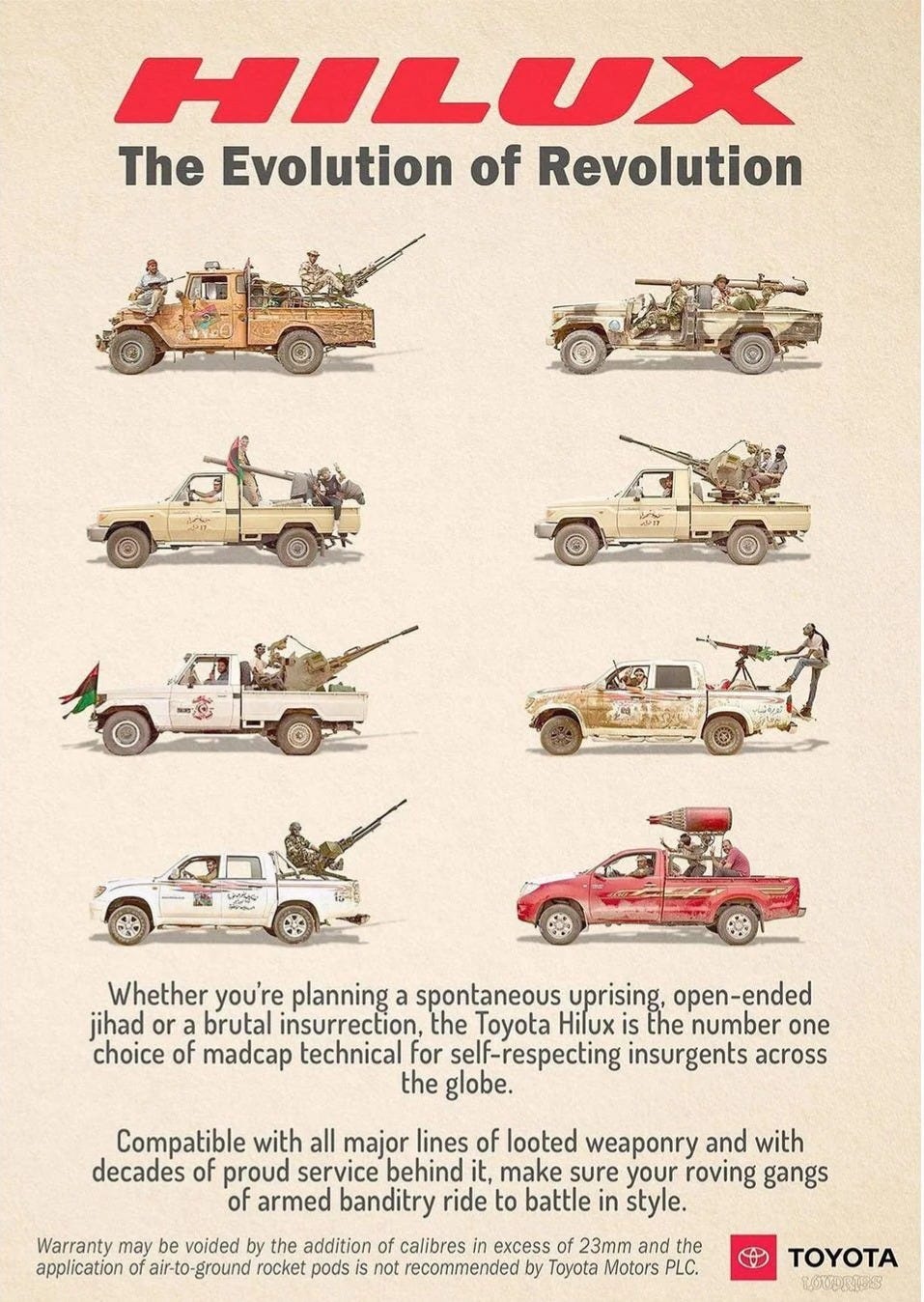
As I laid out in my last note (#14) the groups need money to afford change. We’re going to have to find time and cash to cover any change. Our irrelevant army vehicle fleet is a great place to start. Better to have a motorpool of Toyota Hiluxes — or better yet, a fleet of Kei trucks.
Thanks for posting these and for consolidating them now. I pushed to JSOU who is running a consolidated reader page with the ongoing debate.
https://www.jsou.edu/Press/SOFRelatedReadings?type=SOF-Related%20Readings
As I said in the LinkedIn post, while I may disagree with some of your points in the series, I 100 percent agree that the discussion needs to happen. Self-reflection in a community is a sign of maturity and growth, and questioning and healthy debate should never be discouraged.
Some good points overall. It is necessary for GBs inside the regiment to drive the conversation but not sufficient.
Ultimately, SF needs decision makers in DC and GCCs to understand and truly value SF. Unfortunately, (at least in my experience) this is not that case. And this is mostly on the big Army and SOCOM to sell.
Most in DC do not understand the unique capabilities of SF. Some do understand it but don’t value it, particularly within the IA/IC.
SF needs better integration with the IC if it ever expects to be seen as UW/IW experts at the national level. Roger Trinquier understood this principle. I don’t think many in Army SF truly understand their deep disconnect from the IC.
Separately, GCCs want units that can solve immediate problems not long term IW experts. GCCs are mostly just putting out fires not “campaigning” as they like to claim.
GBs drive the conversation in the team room but someone needs to sell that to those in the NCR…