


Collectively, we wasted the first two years of the Ukraine War doing nothing. Our leaders dismissed the impact of drones on the battlefield. I sat in courses for future battalion and brigade command teams where the army’s senior most four-star generals told the assembled leaders we shouldn’t bother with lessons from ‘two bad armies fighting’ because ‘our tanks drive fast’.1

Since 2024, the inescapability of drones has forced some pundits to change their sentiment, if only a little. Voices now acknowledge the tech has changed, but say the US shouldn’t change the way we fight on such flash in the pan technologies, often because it doesn’t work with our current preferred way of fighting.2 One novel, if suspect, WoTR post likens today’s drones to history’s horse cavalry, proposing professional infantry as the solution to both. Even if you ignore whole chapters historians Azar Gat and Ian Morris wrote on the impact of horse cavalry — which I may be willing to excuse someone not knowing — and the entire history of non-western cavalryman — which I won’t, the author’s diagnosis is wrong.

This is because the drones aren’t the real problem. They’re a symptom. The real, inescapable problem is precision death has gotten cheap.
When Killing Gets Cheap
We have had drones and precision strike capabilities since the First Gulf War. Every single veteran of two-decades of combat in Iraq and Afghanistan knows about drones. We know precision strike even better. Arguably it’s what won us the First Gulf War (1991). On the low end, a Hellfire missile costs just $150,000. To the US these munitions were so cheap we used to fire multiples at the same flip-flop wearing ISIS terrorist. My JOC used to tally the number of college tuitions it took to kill a single terrorist.
That arrogance and indifference to price changed a decade ago, but the US has been ignoring it, at our peril. This is because in the last decade killing me went from unfathomably expensive to so cheap it doesn’t make sense to not to try.

I’ve previously detailed how all the inputs to precision sense and strike have plunged in the decades I’ve been alive. GPS devices of the 1980s weighed twenty pounds and cost as much as a one-bedroom house. Today they are so cheap and infinitesimally light we put them in everything: phones, watches, even dog collars. Cameras, once major household expenses, are so cheap today most cell phones have half a dozen of them. Both night and thermal vision used to be considered military technology just a few decades ago. Now you can buy them at any home improvement store. Even spectrum analyzers and LIDAR have reduced to affordable weight and price points.
Engineers can argue what the acronym stands for, but SWAP generally means the size, weight, and power of a system.3 There are still trade-offs between the various legs, but across the board the weight and monetary cost have shrunk precipitously.
Once thought of as the refuge of the asymmetric fighter, every state worth its salt today is leveraging miniscule monitors to find and hit their opponents.4 This is the minimum buy-in of any conflict. Twenty years ago, even hitting a tank with a Tomahawk didn’t make economic sense. Today, no infantry company can afford to be unprepared for how cheap it is actively working to kill them.
A Stolen March
The west, and the US in particular have ignored today’s economics of conflict. Nearly all our major platforms started rolling off assembly lines over fifty years ago. Our tactics haven’t changed much in the same time span either.
Meanwhile, our adversaries spent the last decade doing everything they could to plug-and-play their way through dozens of iterations, always making sensing and striking bespoke forces ever cheaper. Military technology has always been subject to the Red Queen Effect, but today’s relentless innovation race outstrips anything the US military primes are accustomed to. Mayflies have longer lifespans than some of the forms we have seen iterated in Ukraine. There is no sign of this economic process is slowing down. Because it is powered by economics, not tech.
Today ranges have grown longer and longer, from 10km through 70km, to some as far as 1,500km. At the same time human and computer vision are not providing last meter guidance. Both are finding novel ways to ignore EW and GPS jamming.
The same technologies that came together at a cut-rate price and fractional weight to bring you the iPhone are now upending the rules of mass on the battlefield. Small price advantages, when compounded across thousands of sensors and strikes, produce strategic effects that neither tactical brilliance nor simple maneuver can ignore.
If anything, the economics are accelerating tech innovation into even more dimensions. Having already taken over the world, on land, in the sea, and in the air, agentic AI and cheap satellites are bringing the threat into the remaining two war-fighting domains. Do not get fooled by the competition for expensive premier AI models. For a narrow purpose, you can train and host your own AI model on a laptop. AI is improving every week, and it will never be less capable tomorrow.
What Iran lays bare
We have squandered five years ignoring the impacts of cheap sense and strike. We could have learned from Ukraine, but too many of our leaders willfully ignored their lessons. Any general today who argues maneuver warfare will solve all our problems is echoing the same blind faith in red pants and élan as the French generals of the First World War.
Indeed, the First World War has other rhymes with today. The lessons of both the Boer and the Sino-Japanese Wars were dismissed with the same arrogance as today’s lessons learned in Ukraine and the Bab-el-Mandeb Strait. For years, the US military has struggled to stymie the Houthi rebels in Yemen with “Birkin bag” munitions made by our defense primes. We have spent two years slinging Ferraris at lawnmowers, burning through billions of dollars of hard to replace inventory. At the same time, the Houthi’s managed to turn a profit.

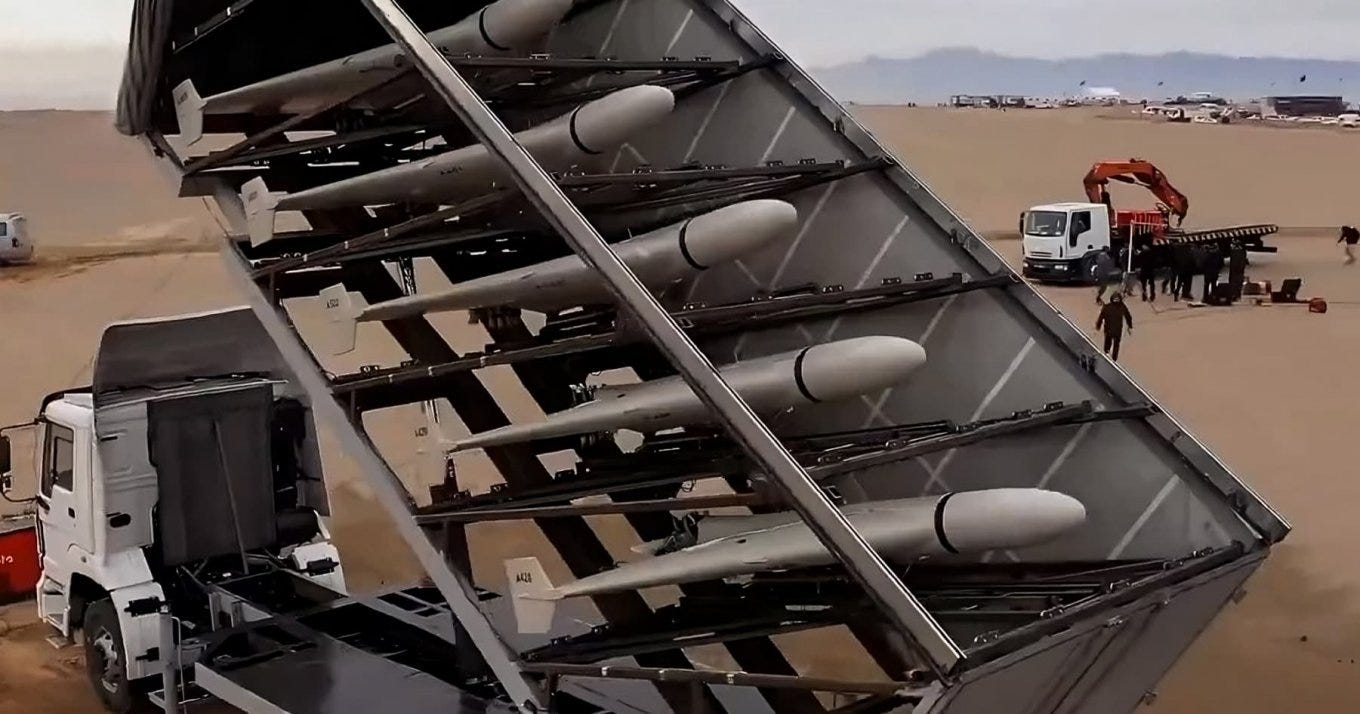
Iran is not Ukraine. Yet we see a similar economic challenge today with Iran. Militaries in the region have mostly managed the ballistic missile threat, but allies across the board are struggling to adapt to Iran’s cheap strike platform, one we have known about for a decade.
Only the US has not prioritized cheap munitions for several decades. The US Navy surface ships today lack guns. The USAF lost one of only 16 AWACS E-3 aircraft after it naively parked it on a runway that had already been struck twice earlier that week.5
The army is little better, championing two-kilometer ranges of cheap drones when the real range starts at over 30km in Ukraine. Both the Arab states and the West have been forced to ask the Ukrainians for their experience. Thankfully, they have offered their help.
We need to change more than the way we fight; we need to transform the way we build and task-organize.
Deception is no longer optional. Too often deception plans have been left to higher headquarters to devise. On today’s battlefield units must carry their own decoys. Multiplies. If your radar cannot move, then you need one hell of an extensive plan to keep it from being struck. Good fucking-luck. It is simply too cheap to find and strike a target today for any force to rely on exquisite ‘Birkin bags’ that cannot quickly reposition.
Launch sites in Iran can extend as far as 1,500 km from their target. Essentially every major US base in the region is within this range. Whinging about Russia and China providing cheap satellite images to Iran is absurd. Aside from that being exactly what conflict has always been about, many of the coverage they want is commercially available. We are idiots for not changing the way we fight.
Combined arms maneuver is still a great way to fight, but it relies on air superiority and secure staging points to fight from. Iran has laid bare what we have ignored for a long time — you rent air superiority, not own it. Below 10k feet, you can barely even rent it. We haven’t started to come to terms with the math challenges of not being able to keep our logistics within 70km of the front for long. Gas and ammo have always been great targets for assholes like me, because both already explode.
We haven’t done anything because we still treat cheap drones like expensive high-end platforms. We need to think of them bullets. The implications of drones as consumables are a series of tough questions about procurement, storage, recycling, and industrial capacity. How are they Expended? Recycled? Army officers Zachary Griffiths and Jeff Ivas made a start, but we need to be aggressively exploring this space.
Countering cheap strikes will require equally cheap methods. Ukraine has mastered layered detection (with cheap sensors) while striking drones with drones or other cheap munitions. The US needs to catch up. We’re already at least half-a-decade behind.
‘It’s the economy, stupid.’
Mick Ryan gets it. Justin Mc gets it. The ladies of Sirens get it.
The Economist definitely gets it. Shashank Joshi, The Economist’s defense editor recently laid the challenge bare.
“…the argument was essentially the technologies of sensors, so drones, satellite, things like that, combined with cheap precision strike weapons were tilting the battlefield away from the people trying to hide on the ground and towards the finders and had a more lethal battlefield. What we’ve seen in Ukraine is the extreme validation of that concept.”
Joshi goes on to discuss the resurfacing of other cheap tactics and technologies, and the rise of commercial actors in war. All of these are challenges the US military, not known for its understanding of economics, must engage with. The US would do well to adopt something similar to Ukraine’s “Moneyball” approach to killing. At the minimum it must begin to adapt to a world where cheap sense and strike are the table stakes of any conflict.
Economic efficiency is an old hand at driving changes to war’s character. It’s responsible for more new tactics than doctrine. Because commanders can choose tactics, but they cannot choose the underlying economics. It is economics which decided not just by what a military can do, but what it can afford to do repeatedly.
The oft lauded German Panzer tank provides just one historical example. The Panzer of the second World War might have been an objectively better tank, but the Allies could produce four times as many subpar tanks which did the job. The US used to be experts in the economics of war. We didn’t beat the USSR with the triad or our tanks. We did it by judoing their economy.
Unfortunately, today we need China to manufacture the weapons we need to fight China. Think the logistics of the Straits of Hormuz are tricky? Try the first island chain where every airfield, every tank farm and depot, every motor-pool are already imaged and inventoried. Try a battlefield where it takes longer to upload an updated image than it takes an AI to identify what’s different.
Swarms are coming too. We humans haven’t solved the problems yet, but we’re getting better every day. And we know it’s a solvable problem — nature has already done it over and over, for a much lower SWAP than anything we’re currently trying.
We need to adapt to an economic reality where killing comes off the shelf and you don’t need a prime to do it.
‘War Never Changes’
The nature of war is still brutish, a violent contest for the will of the people. What cheap sense and strike has done is forever change war’s character.6 Regardless, the Red Queens always gets her races.
Focusing exclusively on the drones themselves will not get us where we need to go. Cheap drones are not, after all, poised to replace humans on the battlefield. Dr. Jack Watling found the logistics tail alone for these new tools absorbs most of the manpower savings. Nor have cheap drones provided the range and power of capital ships. We will still have a use for high end, bespoke weapon systems. Cheap drones do not replace submarines, tanks, or SM6 missile interceptors. They complicate combined arms. They also complicate the fuck out of it. Cheap sense and strike are about exploiting the same seam fast fashion outlets like Temu and Shien leverage. They do not seek to replace high end Gucci bands — they ignore them.
Obsessing over drones leads us to unhelpfully stockpiling cheap drones. The tech is sure to move on before we use them. Designs today critically need modability built in. We need to be able to plug and play different sensors, controls, and even munitions in a way no current weapon system does. Our training and education need to refocus on underlying concepts and the means of production. We don’t need nearly as many people trained on any specific platform. We need people trained on the “theory of drone” who can adapt whatever tools are at hand for tomorrow’s fight.
The economics that gave us cheap drones means we must change the way we fight. But the first thing we need to do is acknowledge the shift. Any argument which claims cheap sense and strike has not altered the character of war is incomplete if it ignores this underlying economic reality. We have already ceded the initiative and years of critical time we need. Failure to adapt to the economics of cheap sense and strike risks is how we ended up in a world of strategic surprise, failing fast on the contemporary battlefield.
The cost of ignoring cheap sense and strike is simply too high.
Luckily for the speakers, the talks were under Chatham House rules.
Pay no attention to two decades of adversaries ignoring our preferred tactics.
IMO, there are only two ways of fighting: asymmetric and badly.
You really need to listen to the ChinaTalk, Now WarTalk podcast. This one is well worth a listen, if only for phenomenal song at the end: ‘It’ll buff out.’ Also, a hat tip for Justin Mc’s phenomenal Substack ‘Mind of Things’.

I have judiciously avoided bothering to wade into the debate about what is and is not a revolution in military affairs (RMA). Arguing revolutionary vs. evolutionary is for historians and pundits, and if the conflict ever resolves, it does so long after the guns fall silent.
Stealing the 'Temu' analogy without remorse. That is such a great way to capture the impact on the cumulative warfare stack. Great write up.
That was another banger