


It’s hard to pin down the origin of New Year’s Resolutions. Stories reach back across countries and cultures all the way to antiquity. Thousands of years ago merely returning borrowed farm equipment was seen as an honorable means to better oneself in the new year. Resolutions seem to be culturally agnostic, as all over the world people found the pivot point between the decline of winter and the rebirth of spring as an impetus to try and be better.
Of course, the tradition of promptly breaking one’s New Year’s Resolutions is certainly as old. We can take heart in the knowledge that much of our failure to keep our goals is just due to entropy. The same law of the universe which causes headphone cords to tangle is helping you failing at keeping your resolution. There are simply more ways to trip yourself up than to stick with your lofty goals.
But science has found a few tried and true methods to help turn your new hopes into habits. And since at least one poll says most American’s reported fitness as their the #1 goal for 2026, I think it’s a great lens to examine habit building
Step 1: Set Modest and Achievable Intermediate Goals.
It’s almost definitional that the first step to any new resolution is to figure out where you want to end up. But the end lives a long way away, especially when life starts getting in the way.

Change requires energy and time, and when you get busy and tired, both of those become harder to manifest.
Research suggests you can improve your chances by having goals, plural. Under your broad heading of ‘be more fit’ or ‘waste less time on social media’, it pays to have intermediary steps. What specific thing can you do to measure your progress? Intermediate goals help by giving you a closer quantifiable target to shoot for. ‘Be more fit’ is easy to say, but what concrete things do you want to improve? By how much?
For me, my year started with a simple fitness goal: Run up Red Hill.
Red Hill is not a big goal. It’s not ‘Climb Mount Everest’, or even ‘Accumulate the total elevation gain of climbing Mt Everest.’ Red Hill’s not even a big hill, only a hair over a 1,000’ ascent. I didn’t have any particularly compelling reason to do it. I wasn’t even going to be the first to run the hill; there is well worn trail right up the side to the ridgeline. I just wanted to see if I could shuffle my way up the trail without downshifting back into a walk. I knocked this one out on my first try in April. Box checked.
The Army gave me my next micro-goal the following month when it rolled out the new AFT standards and test. I needed to prove myself worthy of my MOS by completing the new test at the higher ‘combat standard’ by the end of July.1

Starting early at 0500 trying to mitigate some of the sweltering Honshu heat, my Command Sergeant Major (a tanker) and I both bested the standard in late July, maxing the scores for our age groups. Second box checked.
Which gave me my next goal. I noticed that I was only a couple push-ups and less than half a minute of plank away from getting the max score for a 22 year old. A 44 year old soldier getting a 22 year old’s max seemed too good a meme to pass up.
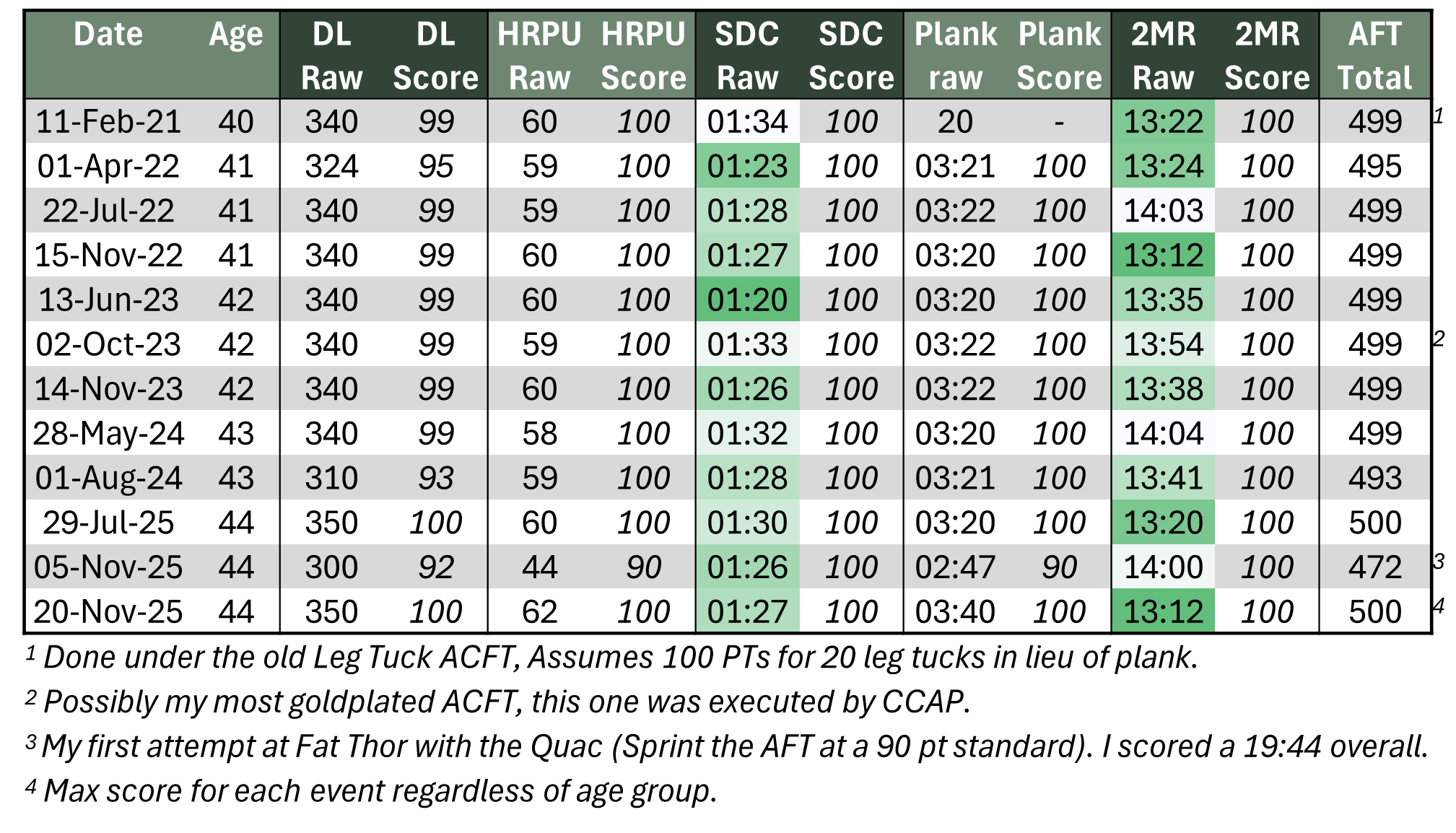
In November I managed to knock out two goals. The first was finally taking on Fat Thor With Extra Guac — a sprint through all five AFT events at the 90 point standard. I bested my goal of 22:04 — the 2 mile passing time for my age — completing all five events in 19:44. Then two weeks later I managed to score the maximum score in all five AFT events regardless of age. Check and check.
Four modest and achievable milestones, each spaced a few months apart as pace beads to motivate myself and track my progress throughout the year. If you want to translate your new year’s resolution into a new you, break yours up into these bite sized chunks. You’ll find it easier to keep the motivation going.
And avoid taking too big a bite right at the outset. When fitness is your goal, that means literally making microtears in your muscles. This is why we get sore. Taking on too much too early is going to require a longer recovery, which works counter to making new habits. Stick with modest steps that accumulate throughout the year.
Step 2: Clear away the 3’ Walls.
A ‘3-foot wall’ is a hurdle so small you could almost trip over it, yet it still stands in your way. An easily surmountable hurdle in our life that inhibits action. You can see right over them. Hell, you can basically just fall over them if leaning hard enough. And yet…
This is why ‘Run up Red Hill’ was such a great first goal. My neighborhood was built around it. I didn’t need to get in the car, buy any new equipment, or even rearrange my schedule. I just had to jog to the end of my street and then start the plod up that trail. This left me without much of an excuse not to do it, which is a huge part of why I did actually do it — in particular given my distaste for running.
David Epstein shared another 3’ wall clearing tip on his Substack:
Going to sleep in workout clothes. It is remarkable how effective that has been in getting me to run or lift first thing in the morning. Somehow, my brain just says: “Look, you’re already dressed, are you really going to change out of running clothes? No. Let’s get after it.” A little weird? Maybe. Working for me? Definitely. Make it easy to make it easy.

Stale workouts and repetitiveness can be another 3’ wall. Part of what drove me away from Army PT was the monotony of push-ups, sit-ups, then run — every single day. Instead, leverage surprise and serendipity to boost your habit building. While dropping into the gym with no plan can work counter to a habit of fitness, knowing your workout in advance can be its own burden.
As a compromise, I do my programming fortnightly.2 This gives me enough time to ensure the workouts are responsive to my health and schedule, but far enough out that I often forget what’s in store until I open up my phone at the gym — I almost never look at the workout until I’m at the gym, because why build your own 3’ wall?
When you’re looking at your goals, take the time to look for the 3’ walls around them. Then eliminate as many as you can. Which frictions are going to trip you up? What time of day best suits your energy levels? Are there things you need — or rather don’t? What’s the ‘sleep in your workout clothes’ trick you can do to make the new habit just falling forward instead of climbing over hurdles?
Step 3: Track your progress.
I’ve written previously about how I leverage checkboxes to hack my neurochemical processes into a bias toward fitness. While checking each one helps condition us to like fitness more, tracking our progress can help us see the invisible progress we make each day.
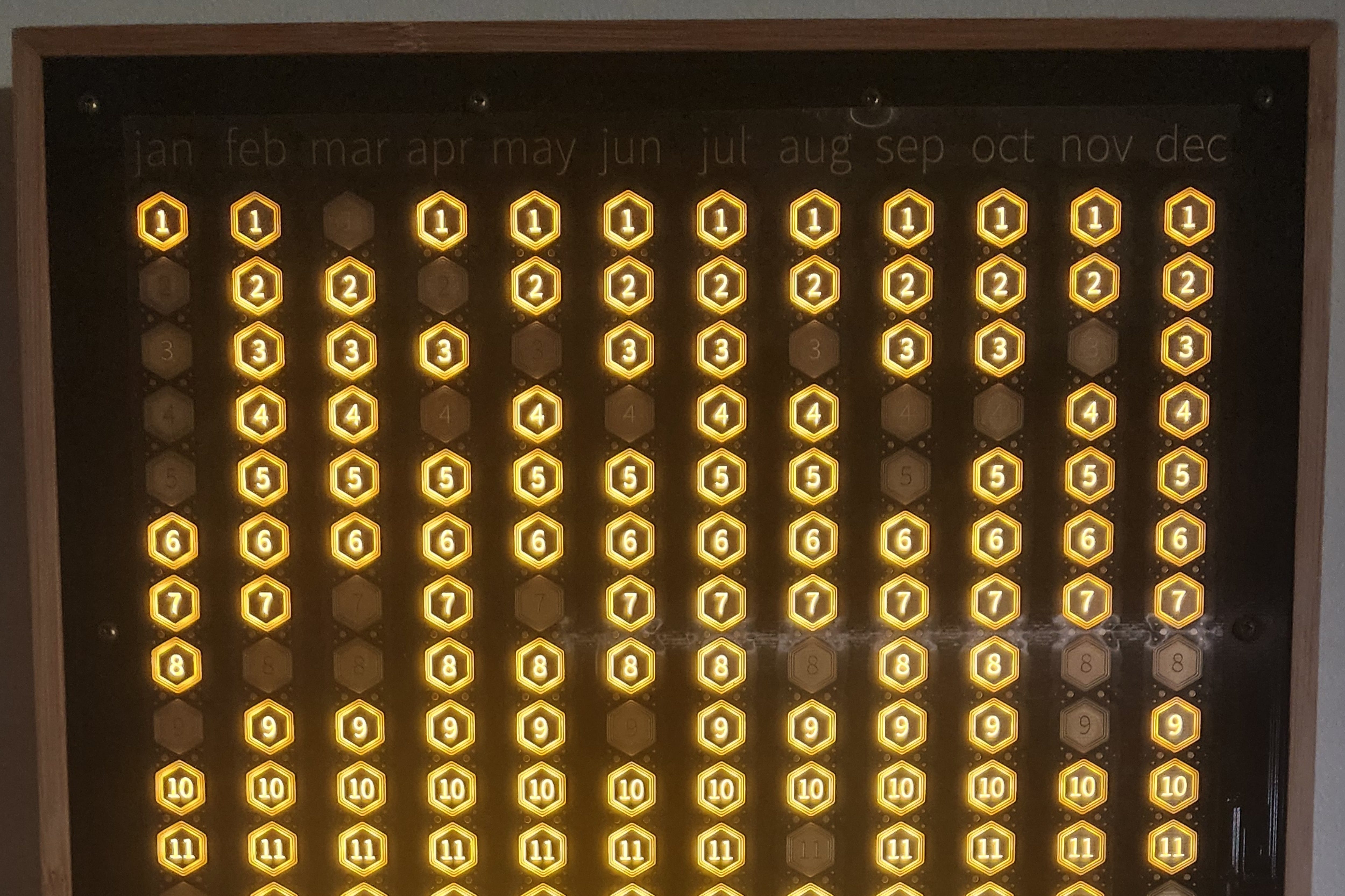
The image header of this post is one of Simone Gertz’s Every Day Calendars. I got in on the Kickstarter years ago, seeing the tool as a way to help my family track my last yearlong deployment to Iraq. Now I use the calendar to help motivate me, tapping on a light for each day I work out.
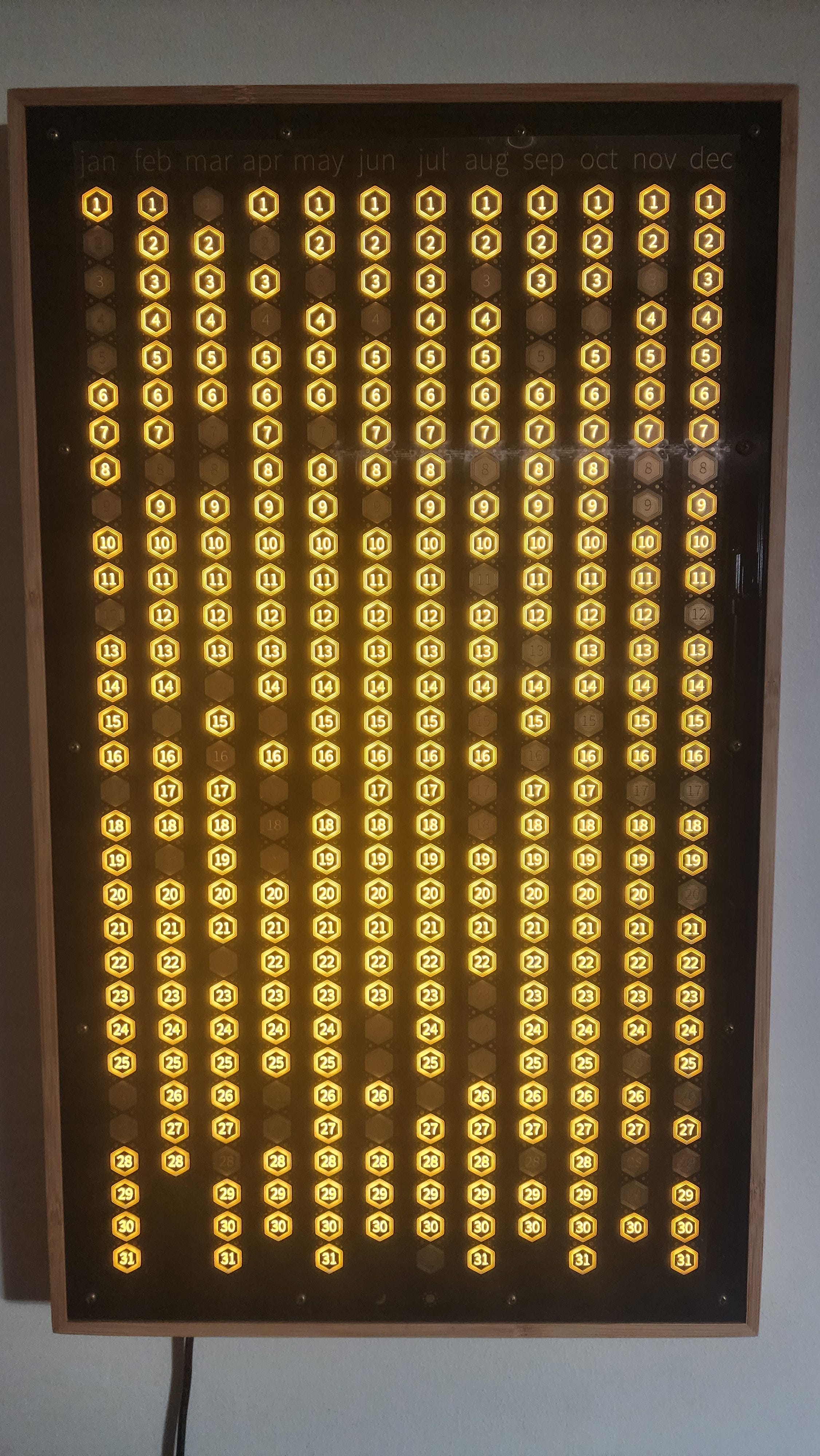
It’s simple, and on some level it’s kind of dumb. But it works. Your invisible progress is made visual. You might find yourself waking up sore, or tired, or just not feeling it, but then you notice, ‘Shit. I’ve haven’t missed a 10th of the month yet. I gotta go today’. And then the opposite pops up, ‘Oh man, I didn’t get a workout in on the 8th the last two months, I gotta go today’. See? Dumb, but effective. And if it’s effective, how stupid is it really?
Old workouts give me drive. While 17 of my 62 PRs in 2025 were from first time workouts — i.e. Fat Thor with Extra Guac — the other 45 were improvements over my previous best. Some were multiple step improvements throughout the year (Tabata Bar Muscle Ups). Others were old dragons I never thought I’d slay, like my 2k Row record set back in 2020. That PR was set after nine solid months of deployment gains. But this spring I sat down on a rower next to my wife and just went full send, shaving nearly 2 seconds to set a new personal best. Not all my PRs this year were endurance / VO2 max. I also set a new high for 8-rep unbroken front squats, my 3-rep Snatch, and my 4-rep Overhead Squat.
Every time you exceed your expectations of a workout, you get an extra burst of dopamine. But to get that hit, your workout must run counter to your expectations. Knowing how well you did last time helps set an expectation that you can exploit for more happy chemicals. Happy chemicals help cement your new habit.
If you aren’t dreading the start of the set just a little bit, then it’s not calibrated right. You should feel some apprehension, just not so much you don’t actually do it.

Beating your PR isn’t even require to get the boost. When the outset of today’s METCON made clear I wasn’t going to finish anywhere near my PR, I had a choice: scale the WoD — lighter weight or fewer rounds — or just let it go. I opted for the later, and even though I finished 7 1/2 minutes slower, I still got to enjoy the dopamine rush, because suddenly ‘Can I even finish this?’ becomes the new expectation to shatter.
Track your progress to reinforce your new habit. This aids to both make the invisible progress visible, and it also helps set the conditions to exploit the same chemical processes typically associated with our worst habits. You don’t need a fancy wall calendar, but if you’re looking for quality tools to help you track your progress, the Kurzgesagt team makes a great Habit Journal that includes even more tips.
Step 4: Enlist Allies.
As I briefly noted above, one of the changes this year was my editor / wife started joining me in work outs. In late January, she asked me to program her a workout once a week. This quickly grew to two, then three workouts, and by the time we moved to Japan we’d settled into five days a week. Because I’m back in regular army land, we only get to work out together Saturdays and Sundays, comparing notes on the other three sessions.
Those weekend WoDS are the easiest for me to get done, and I’ve even taken to saving some of my spicier workouts for them. This is because allies help push you, meaning you don’t need to work as hard to get the energy to do the workout.
The math is pretty simple. If I’m very low motivation, with only a 50% of wanting to work out on any given day, that makes the odds of getting my gains a coin flip. But if I add just one additional person willing to tag along, even if they have the same level of motivation, suddenly the odds of at least one of us being motivated goes up to 75%. It only takes a handful of fellow people committed to always working out if at least one person is up for it to shrink the odds of skipping a workout to less than 1 in a 100. That’s less than four missed workouts a year.
We don’t even have to do the workout together to get the push, though I much prefer those. If my wife is sore from any given day’s deadlifts, woe unto me if I didn’t get my gains.
Taking the time to find other people to join you in making the same lifestyle change is a worthwhile investment. Especially when you all combine the tips leveraged above. Other teammates will suggest additional intermediate steps, they’ll help identify and tear down 3’ walls, and when you can visualize their progress as well, new habits become easier to repeat until they become your muscle memory.
So, before you wake up tomorrow, go round up all those agricultural tools you ‘borrowed’ from your neighbor and give them back. While you’re over there, ask them if they want to join you on your New Year’s Resolution. Sit down and spitball some intermediate steps and ask your LLM of choice for ways to make both of your progress visible.
Good luck in 2026. あけましたおめでとうございます.
2025 Gains Year in Review
At the end of each year, I go back over my logs and do a quick assessment, looking for what I want to tweak. What movements do I want to improve? Which do I want to stop worrying about? What’s working for me, and what’s not?
What was my #1 takeaway of 2025?
I’m Still Not Running.
I worked out 296 of the 365 days in 2025 (81%), which is just above five days a week. Of those, I only ran 77 times (26% of workout days) for an average distance of 1,644m. However, only four of those were 5k or longer, and 7 were Red Hill ‘runs’.3
Take out these, and the three 3.2ks I ran for AFTs and my average goes down to just 1010m on the days I ran. For comparison, I swam 58 days, for an average of 1681m each.
Despite not doing the army standard of long slow runs, I aced all three AFTs this year, as well as my own personal litmus bars.4
I see two main things that continue to contribute to my fitness. First, starting my workouts with three hard minutes on either the rower, the assault bike, or the curve treadmill. In each warm-up set I get my heart rate up into a VO2Max range, before recovering during my mobility work and then finishing with my main set. I did this 212 of the 296 days (72% or roughly four days a week — I usually skip this on swim days). I also focus my METCONs on moderate weight, failure-based workouts where again I elevate my heart rate into VO2Max repeatedly. Workouts where I must stop, recover, and then get back at it.
This setup continues to be high payoff for me. I’ve been doing a variation of this for six years now and my two-mile run times have stayed pretty consistent. Even when taking on Fat Thor with Extra Guac, I managed to finish my two-mile in 14:00.
I continue to argue shifting away from slow repetitive (ab)use runs is the best bang for the buck investments in your fitness. I’ve got six years of data and a dozen ACFT/AFTs to back me up. You can improve your cardio capability while building up the bone and muscle density you’ll need to draw from later in life.
The move to Japan this summer brought me back to the regular army, which has a radically different philosophy and culture of fitness than the one I spent the previous 17 years in. It’s been a bit jarring and disappointing to see how little many soldiers know about building fitness. Most of the units here focus on those army approved long slow runs. When they do add weights, it’s typically only to do bench presses — a movement I hardly do twice a year.
With that in mind, my New Year’s Resolution is to share my fitness knowledge and do what I can to shift the culture. I’m setting out this year to share workouts and tips both locally and here on Substack. Subscribers — it’s still free — will get them in a weekly note. Some will be the ones I’ve already shared in my previous Where Data Meets Gains series — they are, after all, workouts I still do each year. But I’ve got 52 weeks to cover I’ll share new ones as well.
These workouts focus on Moneyball gains — workouts that require minimal kit and avoid highly technical lifts, but provide maximal returns on investment, all at minimum injury risk. So, if you haven’t already, subscribe to make sure you don’t miss out on any of the 52.
Military Occupational Specialty, or your job in the Army, consisting of two or three numbers and one letter. There are hundreds of codes.
A great British word for ‘once every two weeks’, unlike biweekly which might also mean twice a week.
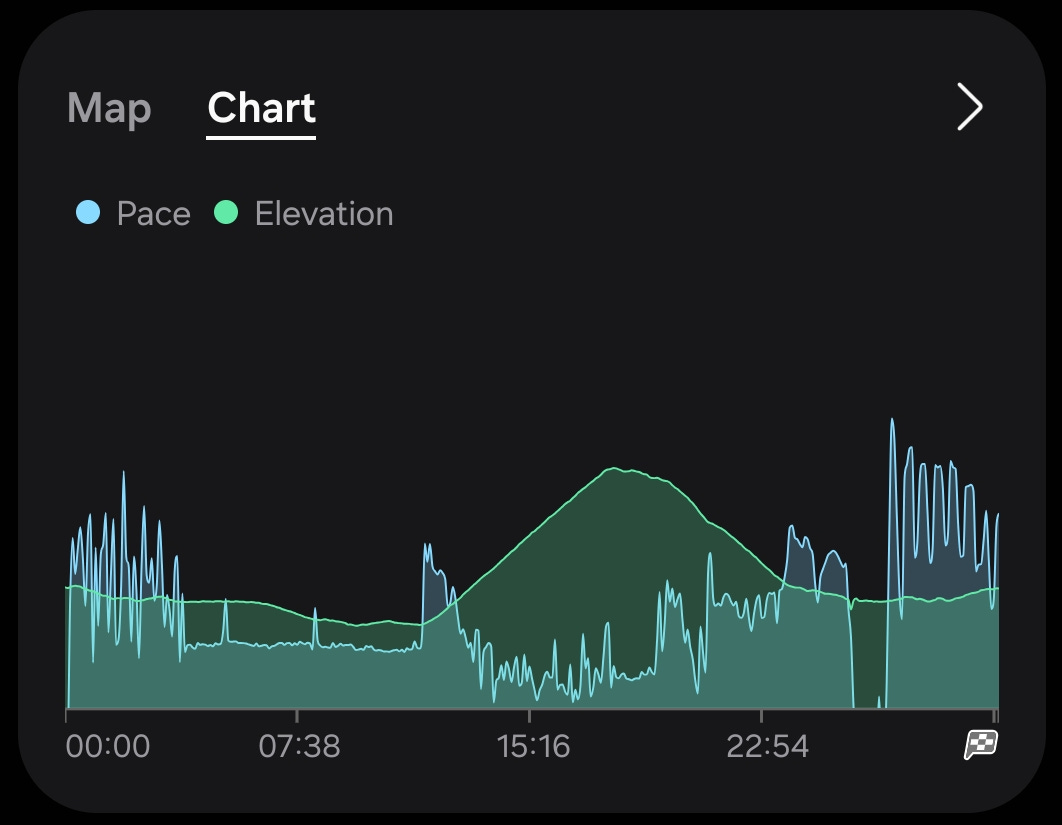
Footnote: Lest any of you think I gave up on my ‘no running’ ways, calling my trudge of Red Hill ‘running’ was being generous, as you can see in the chart below as speed plumets. I capped off each loop with a Tabata Sprint, which is the spiky bit at the end of the curve.
Passing a UBRR in February, and exceeding 325 on Fight Gone Bad in August. With AFTs in May and November, I get a fitness assessment each quarter.